
Readings for the Fifteenth Sunday after Pentecost (Proper 20 Year C)
Jeremiah 8:18-9:1
Psalm 79:1-9
1 Timothy 2:1-7
Luke 16:1-13
This sermon was preached by Fr. Daniel London at Christ Episcopal Church in Eureka CA on September 22, 2019.
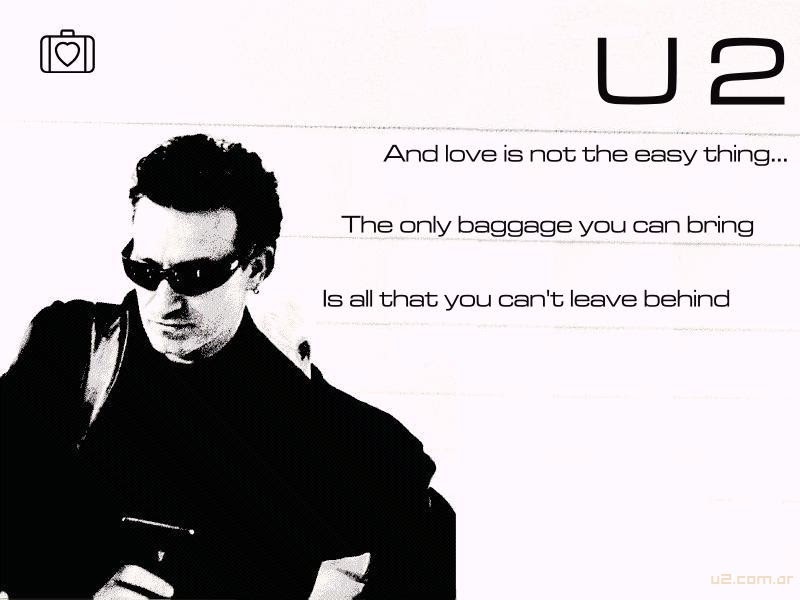
“Love is not the easy thing, it’s the only baggage you can bring. It’s all that you can’t leave behind.” These are the opening words of the song “Walk On” by the Irish rock band U2, a song that inspired the title of their 2001 album All That You Can’t Leave Behind. These words convey the truth that the love we cultivate with friends, family members, partners and even people we meet on the street is the one thing that we take with us after we die. Everything else will be left behind, including “all that we fashion / all that we make / all that we build / and all that we break.”[1] U2’s lead singer Bono knows that the love he cultivates in relationships in this life is the only baggage he can bring with him to the next. Because of his humanitarian campaigning efforts, Bono has been nominated for the Nobel Peace Prize three times, has been knighted by the Queen of England and has been dubbed, by some, as “St. Bono.”[2] He was also being honored at the white house when our friend Betty Chinn received the Presidential Citizen’s Award. Although he will likely not be officially canonized anytime soon, Bono comes from a long line of Celtic Christian leaders, who also understand that the love cultivated in relationships in this life is the only baggage that we can bring with us to the next; love is all that you can’t leave behind.
One of my favorite Celtic Christian leaders is one whose feast day we observed on the last Sacred Saunter of the summer: St. Aidan of Lindisfarne, a seventh-century missionary monk from the island of Iona who shared the Gospel with the people of England. The great English historian known as the Venerable Bede records a story of St. Aidan that illustrates this truth that it is love and not wealth which has everlasting value and which should be given top priority in our lives. This story of St. Aidan also has some helpful similarities to the challenging parable we just heard in the Gospel of Luke.
In order to help Aidan cross rivers and dangerous lands in his diocese, an English king (King Oswald) provided him with an excellent and expensive horse. But after only a few days of traveling with this horse, Aidan encountered a man begging for alms. Immediately, Aidan dismounted the expensive horse and gave it to the poor man. When king Oswald found out about this, he was furious, mostly because that excellent horse was intended for Aidan and his travels. It was not for Aidan to give away to a beggar. The king asked angrily, “Have we not many less valuable horses or other things which would have been good enough to give to the poor?” And Aidan replied to the king’s interrogation, asking, “O King, what are you saying? Surely this son of a mare is not dearer to you than that son of God?” For the king, the mare was a symbol of his great wealth. Aidan was saying “Surely your wealth is not more important to you than this person who is made in the image of God.” Aidan was communicating to the king the truth that the love we give and cultivate with others in this world is worth far more than the wealth that we hoard or flaunt, for that love has eternal value while wealth withers away. Aidan taught this lesson to the king in a way that challenged and disturbed the king and rightly so because that mare was the king’s property, not Aidan’s property. It was not his to give away.
After having some time to cool off, the king eventually changed his mind and threw himself at Aidan’s feet, asking for his pardon and saying, “I will never speak of this again nor will I form any opinion as to what money of mine or how much of it you should give to the sons of God.” The king learned that the love cultivated in this world is the only “baggage” he could bring with him to the next while his wealth would be worthless to him when he died.[3]
The Venerable Bede recorded this story of St. Aidan for the same reason that he recorded stories of many other saints, to inspire his readers to emulate them and their behavior.[4] In the Gospel this morning, Jesus shares a parable for the same reason so that his listeners might learn, be inspired and change our behavior and actions. However, in Jesus’ story, there are no saints. In this parable, Jesus wakes us up, disturbs us and forces us to pay attention. This is not our meek and mild Jesus who lulls us to sleep on Sunday mornings. This is a bold and radical prophet saying, “The children of this age are more shrewd than the children of light,” and “the children of light need to learn from this dishonest and self-seeking thief” and, even more than that, he says, “Make friends for yourselves by means of dishonest wealth”! If we haven’t been paying attention so far, we are paying attention now.
So a rich man learns that his steward has been squandering his property and so he fires him. This steward is not some biblical Robin Hood, stealing from the rich man to give to the poor, as some like to suggest. After he is fired, the steward’s soliloquy is self-centered and does not reflect the thoughts of any philanthropic hero: “What will I do, now that my master is taking the position away from me? I am not strong enough to dig, and I am ashamed to beg.” The steward, however, comes to the realization that if he makes friends with some people during these last few moments as the rich man’s employee, he may be “welcomed into their homes,” which is a first-century idiom meaning “they will help me get another job.” The steward is shrewd enough to know that when it comes to getting a job, it’s really all about who you know. The steward knows the importance of networking and making friends, not because he wants more friends or cares about these people at all but because he knows that if he rubs their back now they will rub his back later. He knows that if he makes their day today they will be grateful and eager to help him out tomorrow. So the steward makes their day, in fact, he makes their entire year! “The debts and reductions are enormous. Fifty measures of oil was worth about five hundred denarii, which was the wage for a farm worker for a year and a half.”[5] The amount of money that the steward gives to the debtors in reducing their debt is not too different from the amount of money that St. Aidan gave the beggar when he handed over the king’s horse. This isn’t pocket change. These are large chunks of cash. And like St. Aidan with the king’s horse, the steward is giving money to the debtors, that is not his to give, he is reducing debt that is owed to someone else. He is giving away the rich man’s money! And what does the rich man do? Unlike the king who was initially outraged with St. Aidan, the rich man seems to bypass the anger and go straight to commending the dishonest steward for acting shrewdly. The rich man is impressed with the steward’s streetwise strategy.
It is important to note that the rich man commends the dishonest steward not for his dishonesty but for his prudence, his shrewdness. As commentator T. W. Manson explains, “There is all the difference in the world between ‘I applaud the dishonest steward because he acted cleverly’ and ‘I applaud the clever steward for acting dishonestly.’”[6] The steward is clever because he knows the importance of making friends in order to save his own neck and in order to get ahead in life.
At the end of the parable, Jesus concludes, “The children of this age are more shrewd in dealing with their own generation than are the children of light. And I tell you, make friends for yourselves by means of dishonest wealth so that when it is gone, they may welcome you into the eternal homes.” Here, Jesus is saying that the children of this age are shrewd in knowing what to do with their money. They spend it on other people, on relationships, on friendships. They do it to get ahead or to save their neck, but they do it nonetheless! While the children of light sometimes don’t do it at all! Jesus is saying, “How much more should the children of light be doing this, especially since they know that the love cultivated in these relationships has everlasting value!” “Make friends for yourselves so that they may welcome you into the eternal homes.”
Now when Jesus says “make friends for yourselves by means of dishonest wealth” he is not encouraging his disciples to be dishonest. Of course not! In the Greek, Jesus says “Make friends for yourselves ἐκ τοῦ μαμωνᾶ τῆς ἀδικίας, which means “Make friends for yourselves out of the mammon (mamona) of unrighteosness (adikias). And “the mammon of unrighteousness” is another idiom that refers to money, but more specifically to our involvement with the webs of deceit and corruption into which all of our money is inevitably woven. Although money is not unrighteous in and of itself, it is likely that the money we have, even the money in our banks and pockets right now, has been, at one time or another, involved in some form of unrighteous exchange. In some ways, we are beneficiaries of corruption, abuse, scandal and slavery. In some ways, the money we have now is money we have at the expense of other people. This is the “mammon of unrighteousness.” And Jesus invites us to untangle these webs of unrighteousness by using our money to invest in our loving relationships with other people, to cultivate and feed the love that will last forever while wealth withers away.
Money itself is not the root of all kinds of evil. Rather, as Paul says in 1 Timothy, it is an inordinate love of money that is the root of all kinds of evil. In other words, “Don’t love money. Use money for love.” Because love is all that you can’t leave behind and because love is what untangles all unrighteousness and yields a universal and everlasting harvest. Amen.
[1] Lyrics from “Walk On” from 2001 album All That You Can’t Leave Behind
[2] http://www.dailymail.co.uk/tvshowbiz/article-1080636/What-St-Bonos-wife-say-partying-teenage-girls.html, accessed September 21, 2013.
[3] Bede, HE 3.14, trans. Colgrave, 132-133.
[4] See “Imitation and the Venerable Bede’s Historia Ecclesiastica,” in Saints Scholars, and Heroes, 2 vols., ed. Margot H. King and Wesley M. Stevens (Collegeville MN: St. John’s University, 1979), vol. 1: The Anglo-Saxon Heritage, pp. 161-90.
[5] Kenneth E. Bailey, Jesus Through Middle Eastern Eyes: Cultural Studies in the Gospels(Downers Grove IL: InterVarsity Press, 2008), 339.
[6] T. W. Manson, The Sayings of Jesus, p. 292 as quoted in Bailey, 341.

 DANIEL DeFOREST LONDON