
Readings for the Thirteenth Sunday after Pentecost (Proper 18 Year C)
Jeremiah 18:1-11
Psalm 139:1-5, 12-17
Philemon 1-21
Luke 14:25-33
This sermon was preached by Fr. Daniel London at Christ Episcopal Church in Eureka CA on September 8, 2019.
“Come, go down to the potter’s house, and there I will let you hear my words.”
As many of you know, my wife Ashley has enjoyed making dishes and jewelry out of ceramic clay. Some of you actually own and wear some of the jewelry she has made, especially her Celtic cross medallions and prayer labyrinths. She’s loved connecting with ceramic artists here like Laura Rose and Julie Cairns and she gets excited and rejuvenated by the process of creating, even though it can sometimes be challenging and frustrating. I have learned from her that sometimes, in ceramics, the potter wants to make the clay into one thing while the clay seems to have a mind of its own and wants to be made into something else. And the clay will remain stubborn until the potter and the clay get on the same wavelength. For this reason, most of the bowls she has made are not really shaped as perfect circles.
I can’t help but think of this when I hear of the prophet Jeremiah’s visit to the potter’s house in our reading this morning, after he hears the voice of the Lord say, “Come, go down to the potter’s house, and there I will let you hear my words.” Jeremiah notices the potter forming a vessel out of the clay which sometimes deforms and folds in on itself requiring the potter to start over and try pulling and forming another vessel out of the same clay. While watching and absorbing this creative act (that’s almost hypnotic to watch), Jeremiah receives prophetic insight about the way God works with God’s people. He hears God say to him and through him, “Hine kachomer beyad hayozer ken atem beyadi” (Look, just like the clay in the potter’s hand, so are you in my hand.) Jeremiah then elaborates on this image in a variety of ways, primarily in an attempt to rouse the people of Israel to repent and thus avoid the impending disaster of Babylonian invasion. However, I feel Jeremiah’s wonderful image of human and divine creativity inviting us to reflect on the creative process in general, a process in which we all participate as people who create and as creatures who are still being created by God. It also makes sense to reflect on the creative process here in Humboldt county, which boasts more artists per capita than any other county in California.
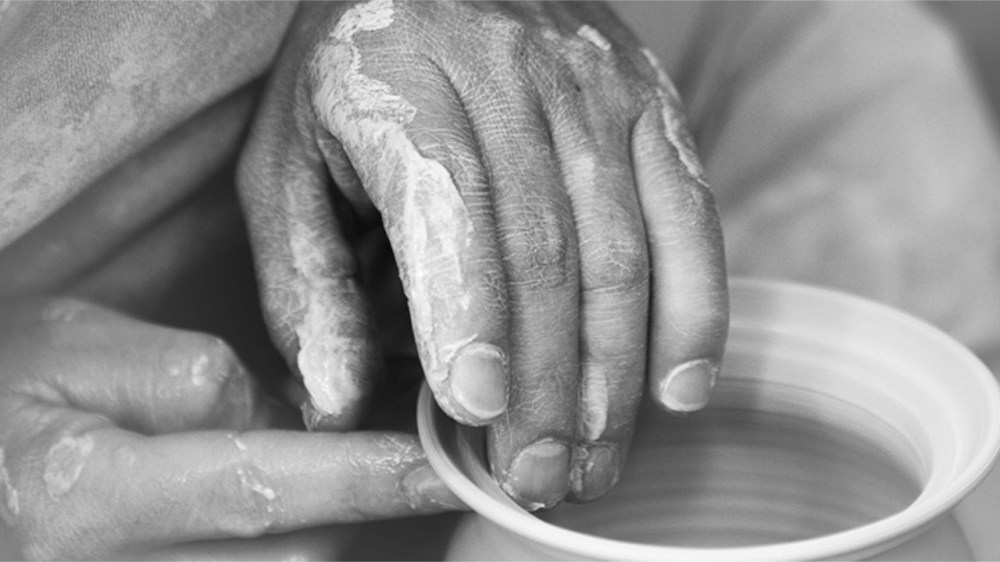
Now we can often have a romantic view of the artist or writer or musician who sits at the desk or studio each day simply allowing the great muse to flow smoothly through him or her to the paper or canvas. What I appreciate so much about Jeremiah’s image is the fact that the potter seems to be struggling. The potter has an idea of what he wants to make and starts to slowly and carefully form it but then it falls apart. So all that time that he put into the project seems to have been a waste because he has to start all over again. I appreciate this because that’s often how I have experienced the creative process.
For example, in my doctoral program, I spent years trying to complete my dissertation just as the potter tried to form the clay. And my work kept deforming and folding in on itself. After more than a year, I felt I had nothing to show for all my hard work. I felt like a potter working tirelessly at the wheel and not producing anything. And there came a time when I had to consider the possibility that maybe these weren’t my gifts. Maybe I should cut my losses and move on to something else. Maybe I did not accurately estimate the cost like the person in Christ’s parable. Maybe I did not consider whether I really had enough mental, emotional and spiritual resources to see my project through to the end like someone who lays down the foundation for a tower and cannot complete it, or like the king who did not have sufficient troops to succeed in battle and must therefore hold up the white flag and surrender. But ultimately I could not give up working on my impossibly stubborn dissertation. I had to sacrifice jobs, teaching opportunities, time with family and friends and time at church in order to keep grinding away at what felt like a lost cause. It took years to get on the same wavelength as the clay of my dissertation, but I finally did and it finally got done. And throughout that process, the divine potter was continuing to mold and form me. As Arthur Holder said at my installation here more than a year ago, I did not need a PhD to become the rector of Christ Church, I needed a PhD to become Daniel. The process formed me into who I am now.
I have learned that part of the creative process involves trusting that God and God’s creativity is at work within us even when things look and feel unproductive and hopeless. The creative process involves giving God the freedom and time to mold us and stretch us and refine us like clay; and it is a process that we ought not enter into lightly. The psalmist in this morning’s beautiful Psalm seems to embody the role of the clay when he says, “You press upon me behind and before and lay your hand upon me” (Ps 139:4). Giving ourselves over to the divine creative process requires immense sacrifice, which may at times feel painful. Jesus knows this very well which is why he warns us in a profoundly disturbing way to not enter lightly into this process of being shaped by God. Last Sunday, Fr. Shewmaker was talking about difficult sayings of Jesus. I gotta say, this is the hardest one yet, especially on a family-friendly Sunday like today. Jesus says, “Whoever . . . does not hate father and mother, wife and children, brothers and sisters, yes, and even life itself, cannot be my disciple.”
The Gospel and this Gospel message in particular is not for the fainthearted. This is Jesus’s hard and harsh way of saying, “If you want to be formed by God’s hands and submit yourselves to the divine creative process, you need to be willing to make serious sacrifices.” And those sacrifices may involve our most personal and profound relationships. They may involve our biggest hopes and dreams. The divine creative process may require us to let go and even give up on a profession, a project or career path. In order to be malleable clay in God’s hands, we need to be willing to let go and sometimes make the most painful sacrifices.
Another great Hebrew prophet, Isaiah, also compared the relationship between the potter and the clay with that of God and humanity when he said, “Woe to those who quarrel with their Maker, those who are nothing but potsherds among the potsherds on the ground. Does the clay say to the potter, ‘What are you making?’ Does your work say, ‘The potter has no hands’?” (Isaiah 45:9). Who are we to question our maker?
And yet, the more I read Scripture the more I see the clay questioning the potter. From Abraham to Job to the Psalmists to Jeremiah and even to Jesus of Nazareth, I see the saints of Scripture question and even quarrel with God. In many cases, it seems that the potter and the clay must work together. There are indeed times when we are called to be submissive and even docile in God’s loving hands, but ultimately we are called to be collaborators and co-creators with God. As the late psychiatrist and theologian Gerald May said, “We are not the authors of our life with God, [but] nor are we pawns. We are participant co-creators. God will be active within us irrevocably, but we bring immeasurable beauty to that process when we affirm it, choose it, and actively join in it.”[1]
The creative process as both a creature and a creator can be brutal and demanding and can require enormous sacrifice. But the God who created our inmost parts and knit us together in our mother’s womb will never give up on us, no matter how stubborn we might be. God wants to co-create with us, as God’s beloved creatures and as people blessed with creativity within ourselves. Some believe the when the Bible says we are made in the image of God it is referring to our impulse to create. And it is by participating in creative work that God works creatively on us.
God invites you to join him in singing the song, in writing the story, in painting the canvas, in molding the clay that is your life. Although the project might feel like it’s going nowhere fast, it is by working with the clay as the potter and by working with the potter as the clay that we can become a vital part of God’s marvelous works, fearfully and wonderfully made. And we can rejoice with the Psalmist and say, “We thank you because we are marvelously made and we have the privilege to marvelously make.” Although we may give up or even feel called to give up on various creative projects, God never gives up on the clay that is our lives. A potter does not just throw clay in the trash because it’s not cooperating. The potter will temporarily take it off the wheel to re-wedge it and then throw it back it on for another pull. As the potter, God never gives up on us, even when we may be stubborn clay.
Today we begin our church’s 150th program year. And this year, we are offering a plethora of amazing opportunities to let the divine potter shape us and transform us, as you can read in our 150th Anniversary brochure. Several long term creative projects have already been brought to their dramatic completion, such as the installation of our new steeple cross and the repainting of our prayer labyrinth, two major “pots” that have been on our wheel for more than a year. These successes should not be overshadowed by the setback that we also experienced this week: the vandalism of the our red entryway doors on H street. We’ll throw the clay of that project on the wheel for some re-wedging, but this setback really adds another layer to our celebration today, because we will bounce back from this as we begin our 150th year, which will be marked by a series of events that showcase the many successes that make up this community and this space. And we will continue to make necessary sacrifices, to trust the process, and to practice patience as God continues the creative work he began in us, 150 years ago.

[1] http://shalem.org/2009/01/01/seeking-the-one-who-has-already-found-us/, accessed September 3, 2016.

 DANIEL DeFOREST LONDON