
Readings for Good Shepherd Sunday (the Fourth Sunday of Easter) Year C
This sermon was preached at Christ Episcopal Church in Eureka CA on Easter Sunday May 12, 2019.
Happy Mother’s Day! And Happy Good Shepherd Sunday! I’m very pleased to be back from a sojourn in Scotland on this day to celebrate motherhood in all its many forms and to worship our divine Good Shepherd with all of you. Mother’s Day and Good Shepherd Sunday invite us to ask the question: How can we help give birth to new life within our families and communities and within the Christian church that is in such desperate need of new birth?
It’s actually not that often that Good Shepherd Sunday and Mother’s Day fall on the same day. It only happens every 7 to 10 years. I personally appreciate this liturgical alignment because it invites me to reflect with you on a particular Celtic saint who is associated with both motherhood and sheep, a saint who I came to know more intimately during my recent Celtic Christian pilgrimage to Scotland, a saint who asks us, “How can we help give birth to new life?”
This saint is one of the three patron saints of Ireland. We all know one of the three: St. Patrick, whom we celebrated here on his feast day which happened to be a Sunday in Lent. The second patron saint of Ireland is St. Columba who was born in Ireland in 521 AD and then traveled up north in 563 to the island of Iona, where I was just last week. On Iona, St. Columba established his monastery and mission outpost for evangelizing all of Scotland. The beautiful, mystical and wild island of Iona remains a central hub for Celtic Christianity today and it might be one of my favorite places in the world. The third patron saint of Ireland is who I want to talk about today and that is the beloved St. Brigid of Kildare who lived from 451 to 525 AD. Brigid was born to a Christian mother and a Celtic father (who was a druid) and she came to embody the integration of Celtic Christianity and pre-Christian Celtic spirituality. One of the reasons why Christian evangelism was so successful in the British Isles was because the missionaries found creative ways to appreciate and integrate Celtic wisdom with Christianity, rather than simply destroy the pre-Christian cultures. (I wish the same could be said about many of the missionaries to North America who failed to appreciate and integrate Native American wisdom with Christianity). Brigid is, in fact, named after a pre-Christian Celtic earth goddess and she may have been a priestess of this earth goddess before she converted to Christianity. (Some argue that the name Britain is connected to the name Brigid because so many of the inhabitants of Britain worshiped the goddess Brigid before Christianity arrived). So even Brigid’s name conveys this integration of wisdom. It is partly for this reason that Brigid is also the patron saint of midwives because she helped give birth to the Gospel, the Christ Mystery, in the British Isles. On this Mother’s Day and Good Shepherd Sunday, St. Brigid asks us: How can we help give birth to new life within our families and communities, and within this church?
Each of us will have our own unique responses to this question, but the life of St. Brigid offers some powerful practices to help us become spiritual midwives and mothers and good shepherds who can revive souls and give birth to new life where it is so desperately needed. I want to offer three ways that St. Brigid helps us to practice spiritual midwifery and good shepherding. It’s important to remember that we ourselves don’t give birth. God gives birth through us. Our job is to create the best possible conditions for the miracle of new life to take place within us and around us.
One way we can do this is by letting go of a scarcity mindset and by trusting in abundance. St. Brigid was known for freely giving away her parents’ milk and cheese and butter to people who were hungry. Although her parents would obviously get upset with her, they couldn’t remain angry for very long because every time Brigid gave food away, it would always be miraculously replenished. She especially loved serving poor people beer and if there was no beer around, then she would turn water into beer. The Irish Christians like to think she turned the water into Guinness. She is known for saying, “I want to give God a lake of beer, and every drop would be a prayer.”
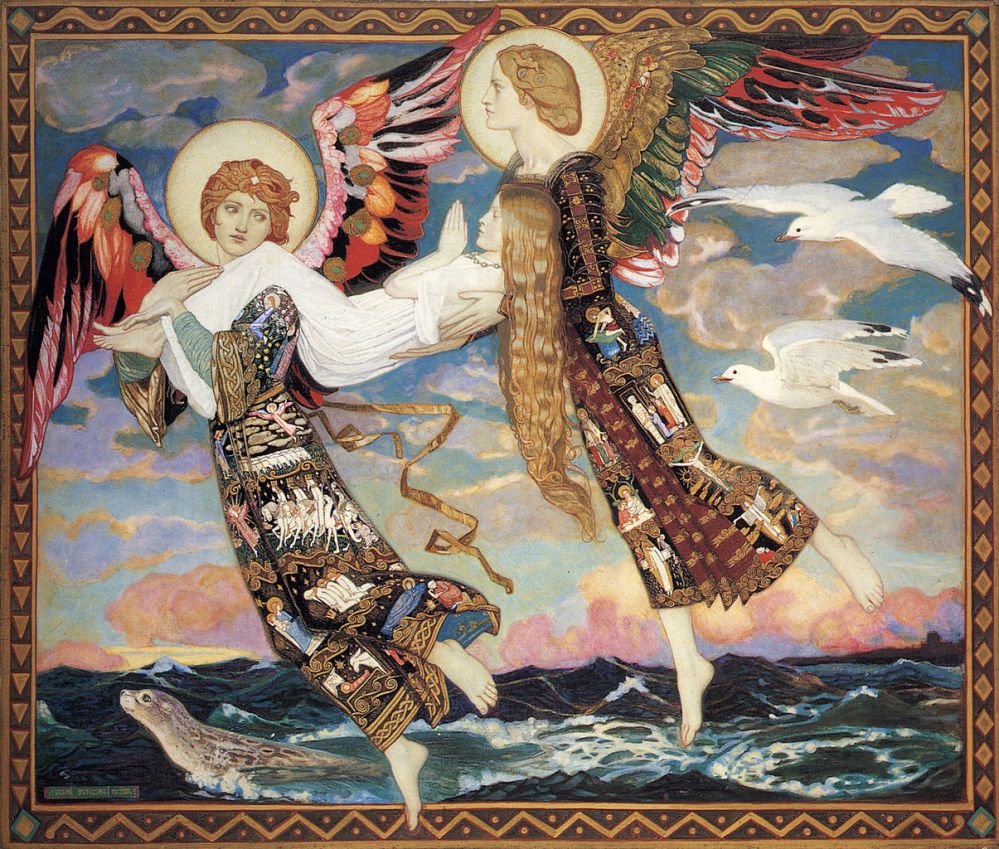
According to one popular Celtic legend, Brigid grew up on the island of Iona in the Hebrides (which actually means the islands of Brigid). And one night while Brigid was sleeping, two angels picked her up and carried her back in time to Bethlehem, where she served as a bartender at an inn. (You gotta love the Celtic imagination!) While she was there, a young couple came in, but the only thing Brigid had to offer was a cup of water and some bread which she was eating. But Brigid decided to operate not out of a scarcity mindset but rather out of a sense of abundance so she gave her bread and water to the young couple. And right after doing so, the bread and water replenished themselves, miraculously.
She then quickly realized that this young couple was expecting and was in desperate need of a warm and safe place to give birth. Brigid knew there were no rooms available in the inn so she put into practice another important discipline: creative hospitality. As someone who grew up tending her parents’ sheep and cattle, Brigid knew that the animal’s manger would serve as a warm and safe space for giving birth. So according to the Celtic Christians, it was St. Brigid’s idea for Joseph and Mary to sleep in the manger and it was Brigid who served as the midwife to the Christ child.
This colorful legend about St. Brigid teaches us the importance of operating out of a sense of abundance (not scarcity) and of practicing creative hospitality, two disciplines that help create the conditions for new life to be born among us. Trust in Abundance and creative hospitality.
Another condition that is absolutely necessary for new life to emerge is the warmth of a close and loving community. St. Brigid tended the perpetual fire at her monastery in Kildare, where everyone in the monastery and in the surrounding village would often gather to enjoy the warmth of the hearth and of each other. This practice continued for centuries in the homes of Celtic Christians and it was the mothers of the household who performed the ritualistic tending of each fire, in the spirit and tradition of St. Brigid. The Celtic Christians knew that healthy, new life could only emerge within the warmth of a loving community.
Another reason I appreciate the fact that today is Good Shepherd Sunday is because I saw more sheep these last couple weeks than I have in my entire life. There were at least a hundred sheep on Iona and the Hebridean islands and Highlands seem to be teeming with sheep and lambs. Although I didn’t notice many shepherds, I did see some very energetic Border Collies, dogs who have been especially bred to herd sheep, to be shepherds. The leader of the pilgrimage John Philip Newell told us about his Border Collie named Jo (which is Gaelic for “spark of life”). John Philip said, “The instinct for oneness is within all things, but it is particularly developed in the Border Collie.” John Philip explained how much Jo loved pilgrimage day, a day when the pilgrims walk about 9 miles on the island, because Jo could then round people up all day. He would look almost “berserk with ecstasy.” At one point on pilgrimage day, we walked in silence to the ruins of a hermit cell, where we then sat in a circle. And that is when Jo would come into the center of the circle, lie down, and go to sleep. And John Philip said, “Of course he would go to sleep, his work was done, he had us in a circle.” Jo the Border Collie functioned as the Good Shepherd who did his job of bringing people together, creating oneness and community, which is absolutely necessary for healthy new life to emerge. This oneness is not conformity but rather different people with different perspectives coming together in love and warmth and joy around the hearth.
St. Brigid’s feast day is the same day as the Gaelic holiday of Imbolc, which is in February, the time of year when mother sheep (ewes) give birth to baby lambs. “Imbolc” means “in the belly” or “in the womb” and refers to the fire within that gives birth to new life. So what is the fire in your belly? In his book titled The Rebirthing of God: Christianity’s Struggle for New Beginnings, John Philip Newell says, “This [fire] is where new life is, in the belly of the earth, in the belly of the human soul. It is not yet seen, but it is stirring. Before long it will try to come forth among us as new birth, with a vulnerability that needs protection and a sacredness that calls for celebration.”[1]
A new era is emerging here at Christ Church Eureka and in our diocese (with a new bishop) and within the wider Episcopal Church and within the Christian Church in general. “It is not yet seen, but it is stirring.” We are invited to help give birth to this new era by trusting in abundance and practicing creative hospitality like Brigid the patron saint of midwives; and by gathering together as a warm and loving community, guided by our instinct for oneness and by the love of our divine Good Shepherd, who seeks to revive our souls and lead us beside those still waters.
There are many sacred wells of St. Brigid in Ireland, but there is only one remaining in Scotland and it is on the island of Iona. The Good Shepherd Sunday readings this morning include the image of still waters and the “springs of the water of life” (uisge beatha). This image reminds me of my last visit to St. Brigid’s well on Iona, where the wind was blowing strong and the water was stirring. At the well, I prayed for all of you and I asked God to give birth to new life among us. I’m not sure exactly what that means, but I’m looking forward to finding out.
O God, whose Son Jesus is the good shepherd of your people: Grant that when we hear his voice we may…follow where he leads; who, with you and the Holy Spirit, lives and reigns, one God, forever and ever. Amen.

[1] John Philip Newell, The Rebirthing of God: Christianity’s Struggle for New Beginnings (Nashville TN: SkyLight Paths, 2014), 103.

 DANIEL DeFOREST LONDON