
Readings for the Fifth Sunday in Lent (Year C)
This sermon was preached at Christ Episcopal Church in Eureka CA on April 7, 2019.
A couple weeks ago, I participated in a Clergy Quiet Day at the Mercy Center in Auburn CA, led by the Rev. Megan Anderson, who used to serve on the clergy staff at Trinity Cathedral in Sacramento, where she founded their holistic wellness ministries. During the Quiet Day, we practiced mindfulness and intentionality by being present to our bodies, by eating silently together, by walking the prayer labyrinth and Stations of the Cross and by sharing with each other what was giving us life and bringing us joy. I’m pretty sure I inspired “holy envy” in my colleagues when I shared with them the joy I was discovering in our weekly Sacred Saunters at Sequoia Park. At the end of the day, the Rev. Megan invited us to enjoy the fragrance of an assortment of oils that she brought with her: almond oil, tea tree oil, sesame seed, rose hips, borage, evening primrose, and others. She then invited us to make our own personal concoction out of our favorite oils by mixing them together in a vial. After doing so, we gathered in a circle and took turns blessing and anointing each other with our own personal oil blend.

As I reflected on this experience, I became more appreciative of this frequently overlooked and overshadowed sacrament, which someone said often gets about as much attention as a white crayon. The sacrament of anointing is known as “unction” and it made me think of conversations I’ve had here during this Lenten season in our Introduction to the Episcopal Church class and in our exploration of Celtic Christianity. Just last week, I discussed the seven sacraments of the church: Baptism, Eucharist, Confirmation, Ordination, Matrimony, Confession and Unction. The sacrament of unction should not be understood as peripheral or minor within our tradition but rather as central to who we are as Christians.

What does the word “Christian” mean? You might say that it means ‘we are followers of Christ’ and you would be right. But what does the word “Christ” mean? It’s from the Greek word “Christos” which means “Messiah”? And what does “Messiah” mean? It means “The Anointed One,” “The One who is Anointed with Oil,” “The One Who Has Received Unction.” In the ancient world, the prophets and priests and kings were anointed with oil as a sign and symbols of God’s favor and blessing. For the kings, it was equivalent to being crowned. As Christians, we are indeed followers of Christ, but we are also “Anointed Ones.” We are those who have been blessed and anointed with God’s favor to be royal priests and prophets in this world. I appreciated the Rev. Megan getting us in touch with our oily roots, as Christians, as Anointed Ones.
Also, in our discussions of Celtic Christianity, we have explored the Celtic way of praying not just with our minds and mouths but with our whole bodies, all of our senses. Celtic Christianity includes some of the most corporeal, fleshy and down-to-earth prayers in all of church history. They have prayers for lighting fires, for washing hair, for enjoying the sun, for hunting, for curing indigestion or toothaches, for listening to the language of the birds, and for discovering the Trinity in trees and plants and water. This Celtic Christianity, which fused with Roman Christianity makes up the spiritual heritage that we inherit as Western Christians, and specifically as Anglican Christians. We can claim this heritage by praying with our whole bodies, all of our senses. And the sacrament of unction helps us to pray in this Celtic way.

In today’s Gospel, Mary of Bethany prays in this Celtic way by praying with her whole body, arousing multiple senses, and leaning into the earthy dirtiness of everyday life. She pours a pound of pure nard all over Jesus’s feet, making a wonderful oily mess and filling the entire house with the fragrance of her perfume. Now, in the ancient Near East, people did not wear shoes or socks and the roads were very dusty and sometimes covered in camel dung. So the feet of a peripatetic rabbi like Jesus would have been extremely dry, dirty and probably quite stinky. And Mary kneels down and pours valuable oily perfume all over these dry and dirty feet. And just when the onlookers thought that this act of extravagance could not get anymore excessive, she then starts wiping the oil on his feet with her hair! It was rare for Jewish women, at the time, to even unbind their hair in public at all, much less to wipe a man’s dirty feet with it. Mary prays with her knees, with her hands, with her expensive perfume and with her hair. Her prayer becomes a multi-sensory experience for her and for everyone watching as the oil glistens and gushes before their eyes and ears and as the fragrance overwhelms their nostrils so much that they can almost taste it. The act is so human and sensuous that it actually scandalizes and horrifies some of the onlookers. According to Luke’s version of the anointing, the onlookers called the woman a “sinner.”

Judas Iscariot especially did not approve of this extravagance and asks, “Why was this perfume not sold for three hundred denarii and the money given to the poor?” 300 denarii would be equivalent to about $60,000 today. So that is certainly some expensive oil and perfume. Judas suggested that the money earned from selling the oil could be given to the poor, which actually sounds like a pretty decent suggestion, right? Although the Gospel is clear that Judas Iscariot has no interest in serving the poor and simply wanted to fatten the common purse in order to steal more from it, I am still initially bothered by Jesus’s response, when he says, “You always have the poor with you.” He sounds rather dismissive of the plight of the poor. It sounds like he’s saying, “There will always be poor people around no matter what you try to do about it. So you should probably be focusing on something else instead of wasting your time with them.” Fortunately, a closer look reveals that Jesus is saying something very different than that. In fact, Jesus is quoting Torah. Any Jewish listener would know that Jesus is referencing the book of Deuteronomy, which says “There will always be poor people in the land” (15:11) a verse that is sandwiched between two commandments to serve the poor. The prior verse is “Give generously to the needy and do so without a grudging heart” (15:10). And the following verse is “Therefore I command you to be openhanded toward your fellow Israelites who are poor and needy in your land.” So by saying “You always have the poor with you” Jesus is, in fact, invoking the divine command to be generous to the poor.
However, even with this understanding, Jesus still seems to give special preference to Mary’s act of devotion over and above service to the poor. So what is going on here?
I think Jesus is saying, “You always have the poor with you, but you do not always have me.” By saying this, Jesus is stressing the importance of his physical body, his embodied presence, which allowed Jesus to be present to his first disciples in a way that we today can only imagine. Today, we cannot touch or be touched by the physical and historical Jesus of Nazareth who lived 2000 years ago. If we had the chance to travel back to any historical time period, I imagine many of us would choose to visit the land of Palestine at the time of Jesus so that we might see him in the flesh. Jesus is inviting his disciples to appreciate how God is being made manifest to them at that moment in his physical human body. Many people think that Jesus, especially in the Gospel of John, has a low opinion of the human body and the flesh, but here Jesus is inviting his disciples to appreciate his human flesh. And by doing so, Jesus invites us to appreciate our own human flesh, to get out of our heads and into our bodies. Jesus is inviting us to pray in the Celtic way like Mary with all of our senses.
When we get stuck in our heads (as I often do), we fail to be fully present to ourselves and to others. In the Gospel, Judas Iscariot gets stuck in his head. His wheels start turning as he tries to figure out ways that he can benefit from the situation. When we get stuck in our heads, we can easily fall into the kind of “charity” that Judas Iscariot fell into, one which is more concerned with how it will benefit us, how it will make us feel special and generous and holy. A charity that gives to the poor from a distance without getting too close to them, without getting dirty, in order to make us feel extra clean and special. When we pray with our whole bodies, our ministry to the poor can be enhanced as we bring our whole selves into our God-given roles of royal priests and prophets, of “Anointed Ones” (Christians) and as we learn to practice an incarnational ministry of physical presence.
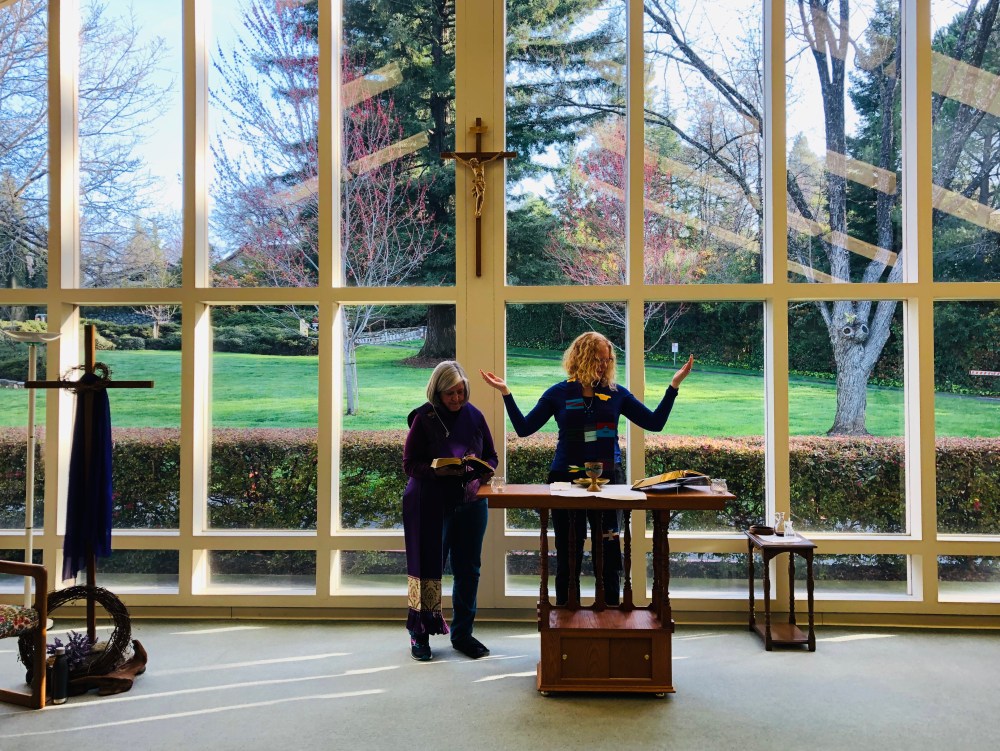
I urge us this morning to pray in this Celtic Way by inviting you all to remain at the altar rail after receiving communion so that I can I then anoint you on the forehead in the Name of the Trinity with the holy oil I mixed at the Mercy Center. In this way, we can remember and claim our identity as Christians, as those who are anointed by God to be royal priests and prophets in the world, praying and serving the poor with our whole bodies. Amen.

 DANIEL DeFOREST LONDON