
Readings for the Fourth Sunday in Lent (Laetare Sunday – Year C)
This sermon was preached at Christ Episcopal Church in Eureka CA on March 31, 2019.

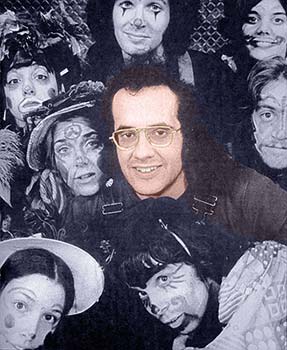
In 1970, a young graduate student at Carnegie Mellon University named John-Michael visited an Episcopal cathedral in Pittsburgh two weeks before his master’s thesis was due. Although John-Michael was initially interested in writing on Greek and Roman mythology, his interest and energy had waned considerably and it seemed that he would likely not be meeting his deadline. During this time, he was becoming deeply fascinated with the Gospels in the Bible, which he felt expressed something that he did not encounter in the same way anywhere else: and that was joy. So with two weeks left to write his thesis, he visited St. Paul’s Cathedral in Pittsburgh hoping to be inspired and to experience more of that joy at the most important worship service of the entire liturgical year: the Easter Vigil service. On that night, John-Michael wore his usual t-shirt with overalls, which caused some of the parishioners to turn their heads and give him some looks of displeasure. And apparently, one of the parishioners who was a police officer was so suspicious of him that he frisked him for drugs after the service. Needless to say, John-Michael did not discover in the cathedral the same joy that he felt expressed in the Gospels. He said, “I left with the feeling that, rather than rolling the rock away from the Tomb, they were piling more on.” Although this was disappointing for John-Michael it also proved to be inspiring because he then went home, took out his manuscript, “and worked it to completion in a non-stop frenzy.” What he wrote that Easter night became his thesis and the script for one of the most successful off-Broadway musical plays in history. John-Michael said that he wanted the play to convey “the simple, joyful message that [he] felt the first time that [he] read [the Gospels] and [he wanted to] recreate the sense of community, which [he] did not share when [he] went to the [church] service.”[1] John-Michael wanted others to experience the joy he discovered in the Gospel of Jesus Christ.

We are still in the season of Lent; however, today you will notice that we are not wearing our usual purple vestment but rather our new rose-pink vestments, which we wear only twice a year: on Gaudete Sunday, the third Sunday in Advent and today, Laetare Sunday, the fourth Sunday in Lent. These days are intended to be joyful respites in the midst of penitential seasons, reminding us that the glorious feasts that we await (Christmas and Easter) are just around the corner. “Gaudete” and “Laetare” both Latin ways of saying “Rejoice!” And today’s Scripture readings invite us to do just that: to discover joy. In the reading from Joshua, God “rolls away the disgrace of Egypt” for the Israelites by feeding the children of Israel with food produced by the land, the land of promise. After decades of slavery in Egypt and wandering in the wilderness, the Israelites finally discover the joy of arriving at home. Just as God rolled away the disgrace of Egypt for the Israelites so too does God roll away our sins and transgressions with his forgiveness as the Psalmist exclaims in Psalm 32: “Happy and joyful are they whose transgressions are forgiven, and whose sin is put away!” Or as the Apostle Paul puts it, “Everything old has passed away; see, everything has become new!” (2 Corinthians 5:17). Paul then continues to elaborate on the joy he has discovered in his ministry of reconciliation. And our Gospel reading includes one of the most familiar and beloved parables of Jesus that is all about the joy of reconciliation within a family. In the parable, we witness the joyful reconciliation between a loving father and a reckless and eventually repentant son. This joyful reconciliation between the father and son has inspired masterpieces by painters such as Rembrandt and authors such as Henri Nouwen and William Shakespeare. (More than any other parable of Jesus, it is this parable of the Prodigal Son that most influenced William Shakespeare in the writing of his plays.) However, this parable (like most of Jesus’s parables) leaves us a little bit in the lurch, particularly regarding the relationship between the two brothers. The joy that characterizes this day (Laetare Sunday) and the joy expressed in the other Scripture readings for today seems to be slightly tainted by this resentment between the two brothers at the end of the Gospel. And the joy of the day and the readings can quickly turn into personal conviction and sorrow as this sibling tension may remind us of resentments within our own families and communities, grudges we hold against friends and neighbors and loved ones. Perhaps this is exactly what Jesus is inviting us to consider by leaving us in the lurch. Perhaps he’s calling us to recognize the ways that we are like the older brother and the ways that we cling to our own self-righteousness at the expense of wholeness and reconciliation and joy.
The Gospel invites us to rejoice on this Laetare Sunday and to let go of those things that we think make us righteous but are ultimately joy killers. Sometimes we find power and strange pleasure in holding a grudge against someone whom we feel has offended or wounded or disrespected us or our family or our community. I confess that I’m guilty of this. But the truth is that holding a grudge against someone is like drinking poison and waiting for the other person to die. Let us not drink that poison because it will kill our joy and it will destroy our souls.
New Testament scholar Amy-Jill Levine has tried to understand how the original Jewish listeners of Jesus’s parables understood them in the first century. In her book titled Short Stories by Jesus: The Enigmatic Parables of a Controversial Rabbi, Levine hears this parable provoking listeners (including us) with the following exhortations: “Recognize,” she says, “that the one you have lost may be right in your own household. Do whatever it takes to find the lost and then celebrate with others… so that you can share the joy. Don’t wait until you receive an apology; you may never get one. Don’t wait until you can muster the ability to forgive; you may never find it. Don’t stew in your sense of being ignored, for there is nothing that can be done to retrieve the past…. Instead, go have lunch. Go celebrate, and invite others to join you. If the repenting and forgiving come later, so much the better. And if not, you still will have done what is necessary. You will have begun a process that might lead to reconciliation. You will have opened a second chance for wholeness [ …] and joy.”[2]
John-Michael’s musical play was a modern and comical re-telling of the life of Jesus set in New York City with a particular emphasis on Jesus’s parables. In his re-telling of the parable of the Prodigal Son, John-Michael adds to the story by providing a joyful reconciliation between the two brothers. In the play, the brothers initially refuse to even look at each other, but then “the father comically knocks the brothers’ heads together so that they fall on their knees and then hug as the father says, ‘Them’s my boys.’ And the scene ends with everyone cheering and applauding enthusiastically at restoration within the family.”[3] If you haven’t already guessed it, the musical play I’m talking about is Godspell, which John-Michael Tebelak wrote after attending the Easter Vigil service in Pittsburgh. All of the songs in Godspell are inspired and based on Episcopal hymns, (including the song “Day by Day” which we will sing during Communion.) John-Michael Tebelak was a life-long Episcopalian who considered a call to the priesthood and served as the Drama and Liturgy Consultant at the Cathedral of St. John the Divine in New York City, where there is now a theater named after him. If he were on the church’s calendar of saints, his feast day would be this Tuesday because he died on April 2nd of a heart attack at a young age, apparently because his heart was too big. Although I am personally not the hugest fan of Godspell, I admire John-Michael Tebelak and I very much appreciate how well his masterpiece captures the Gospel’s invitations to discover joy by not taking ourselves so seriously, by letting go of our grudges (which are really only hurting us), by practicing gratitude, and by falling headlong into the loving and forgiving arms of our most generous God who joyfully says to each of us, “All that is mine is yours.” Amen.
[1] Carol de Giere, Defying Gravity: The Creative Career of Stephen Schwartz, from “Godspell” to “Wicked” (New York: Applause Theatre & Cinema Books, 2008), 45, as cited in David B. Gowler, The Parables After Jesus: Their Imaginative Receptions Across Two Millennia (Grand Rapids MI: Baker, 2017), 231.
[2] Amy-Jill Levine, Short Stories by Jesus: The Enigmatic Parables of a Controversial Rabbi (New York: Harper, 2014), 69 – 70.
[3] Gowler, The Parables After Jesus, 232.

 DANIEL DeFOREST LONDON