
Readings for the First Sunday in Lent
This sermon was preached at Christ Episcopal Church in Eureka CA on March 10, 2019.
This Lent, we have already had many opportunities to slow down and listen to what the Celtic Christians call “the heartbeat of God” beating in all of creation. On Ash Wednesday, we slowed down to listen to God’s heartbeat within the dust of our humanity. In the Ash Wednesday readings, we heard Jesus tell us not to practice our piety on the streets to be seen by others; and then we went out on the streets for our Ashes-to-go service and our piety was seen by thousands because we were on front cover of the Times-Standard. There’s some incongruity, isn’t there? But if you remember, on Ash Wednesday, I reminded us that Jesus also told us to let our light shine so that others may see our good works and give glory to our Father in heaven, so that others may become more aware of and attuned to the divine heartbeat. I hope our picture on the Times-Standard brought people’s attention more to God than to us.
On Friday, many of us gathered here to slow down and listen to the heartbeat of God pulsating through the sensuous and sonorous and mystical music of the magnificent organist Jonathan Dimmock, who invited us to put aside our many distractions and look inward as we listened attentively to all the subtleties of Widor’s fifth organ symphony.
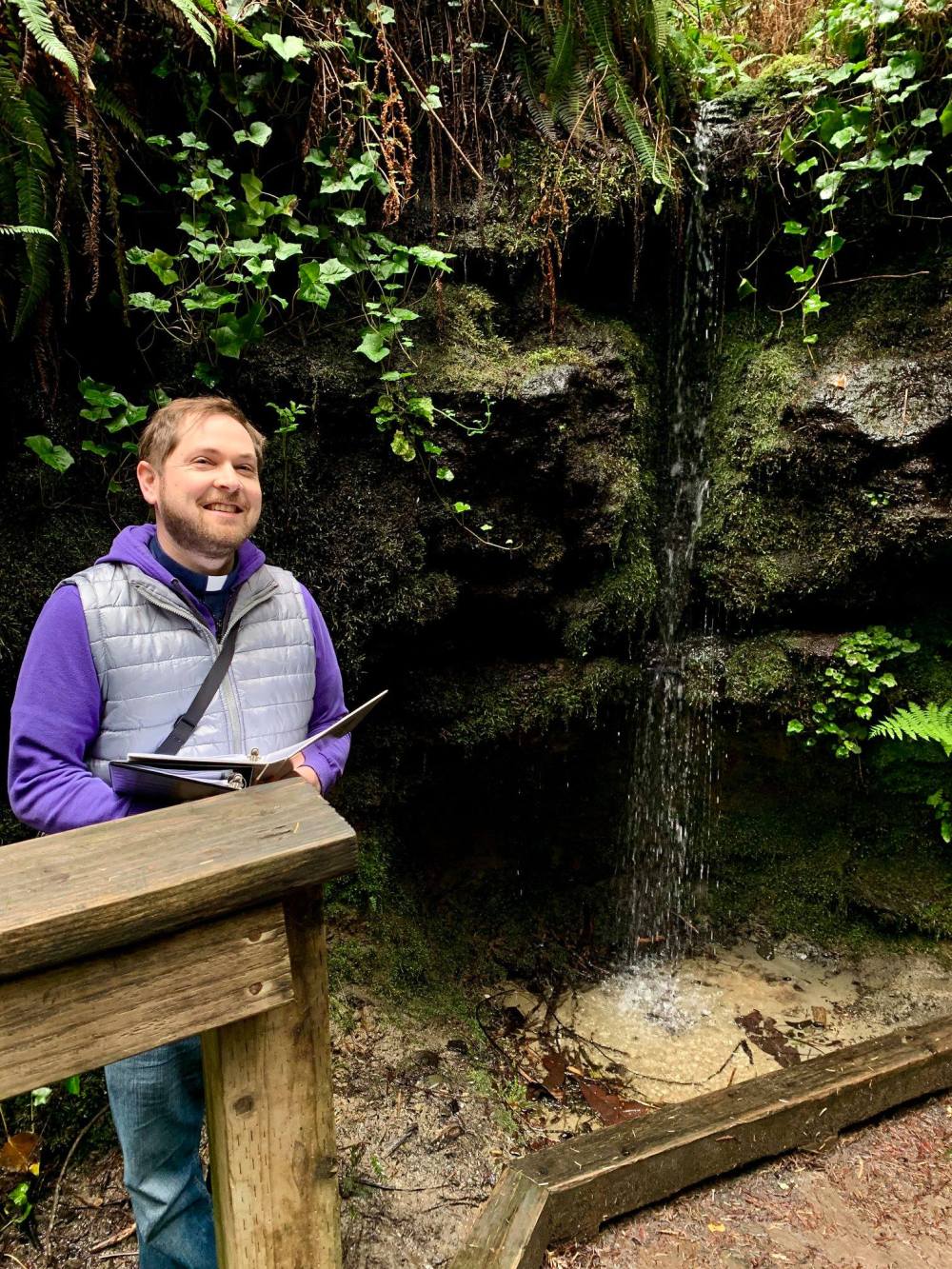
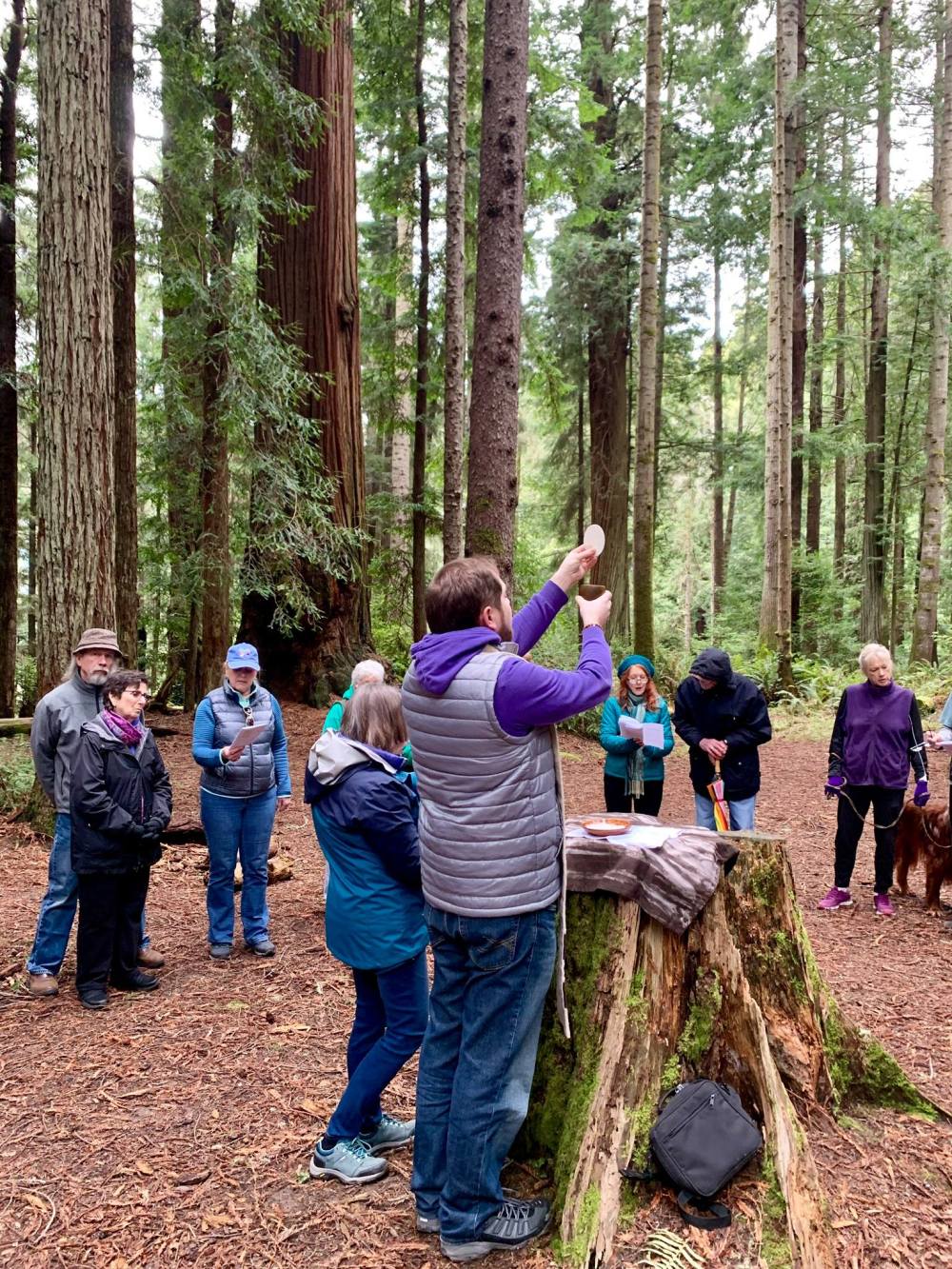
And yesterday, about 30 of us gathered for our first Sacred Saunter at Sequoia Park, where we heard sacred Scripture read while water rippled and flowed in the background, where we absorbed the oxygen-rich forest with all of our five senses, where we laughed as a goose honked loudly in the middle of our prayers, and where birds surrounded us with song as we celebrated Eucharist on a tree trunk altar. As we slowed down together, I think we all heard and felt the heartbeat of God. May that be the invitation of Lent for us this year (and every year): to slow down, to let go of all the busyness that makes us feel so important and to listen to the heartbeat of God, the God who deserves all the glory.
In our Gospel this morning, Jesus is led by the Spirit into the wilderness where he is tempted by the devil for forty days. This takes place right after he was immersed in the living waters of the Jordan River, where the heartbeat of God pounded so loudly within Jesus that he knew he was God’s beloved child (as the voice from heaven declared) and he knew that God’s heart was his own. It was with this knowledge that he went into the desert.
The devil’s proposals to Jesus to miraculously make bread, to escape death and to become glorified in all the world were extremely tempting for Jesus because he really wanted to accomplish these things. We know he wanted to do these things because later on in Luke’s Gospel, he does all of them: He miraculously makes bread to feed thousands of people (Luke 9:12-17), he escapes death in his resurrection and then he is worshipped and glorified by his disciples who then proclaim his glory to the rest of the world (as Luke describes in his sequel: the book of Acts). So does this mean that Jesus eventually succumbs to the devil’s temptations? Absolutely not!
Jesus fulfills his deep desires, but he does so in rhythm with the divine heartbeat with which he is attuned. He fulfills his desires in God’s time and in God’s way, rather than in the devil’s way. The devil essentially offers him the fast-food approach of instant gratification, the McDonaldization of the Messiah, which we all know is tempting indeed. But God’s way often requires patience (“giant sequoia patience”) and sometimes sacrifice and suffering. I imagine Jesus responding to the devil’s temptations by listening to his own divine heartbeat, which told him, “Slow down. This is not the time nor the way to receive what God has in store for you.” The timing was right for Jesus to miraculously make bread when there was more than just his mouth to feed. And the timing was right for Jesus to escape the clutches of death only after he had endured the suffering of the cross and the grave.
Luke’s Gospel teaches us that when it comes to the spiritual life, the fast-food approach is dangerous and deadly and even diabolical. This is why we don’t just hop like a chocolate covered Easter bunny from Epiphany to the Great Feast of the Resurrection. We first walk the via dolorosa of the Lenten season. And during this season, we train ourselves to hear God’s heartbeat and to trust in God’s time and to follow God’s way, even when it may be full of difficulty, pain, self-denial, and boredom. I know that many of us are walking this painful path right now; and it is very hard. And sometimes I wonder why God has set it up this way. Why does part of the Hero’s Journey include that grueling descent into the abyss before victory can be enjoyed? Maybe it’s because the victory would be hollow if there were no real struggle and challenge. Why do we have to walk the slow way of the Cross before we get to Easter? Maybe because this is the path that slowly transforms our heart into God’s heart.
Psychiatrist Elisabeth Kübler-Ross said, “The most beautiful people we have known are those who have known defeat, known suffering, known struggle, known loss, and have found their way out of the depths. These persons have an appreciation, a sensitivity, and an understanding of life that fills them with compassion, gentleness, and a deep loving concern.” These persons have listened to the heartbeat of God and have set their lives in step with that divine rhythm, which is often much slower than we might want it to be. God wants us to flourish and thrive and God has many tremendous blessings in store for each of us and for Christ Church Eureka. But, in order to claim them, we must first walk the way of the Cross. Before we can properly celebrate the glorious resurrection on Easter Sunday, we must first slow down to observe a holy Lent and to feel the heartbeat of God in the trees at sequoia park, in the candlelit silence of Compline, in Centering Prayer, in the spiritual treasures of Celtic Christianity, in the music from our organ and choir, in the person sitting next to you right now, in our friends and loved ones who are sick and suffering, and in the bread and wine made holy so that our heart can slowly become God’s heart. Amen.

 DANIEL DeFOREST LONDON