
Readings for Saturday after Ash Wednesday
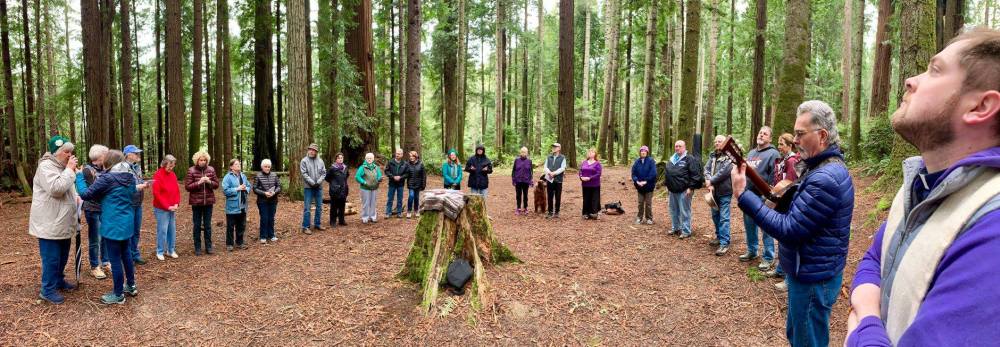
This reflection was shared at Sacred Saunter Outdoor Eucharist on Saturday March 9, 2019 at Sequoia Park in Eureka.
“Those who are well have no need of a physician, but those who are sick; I have come to call not the righteous but sinners to a change of heart and mind.”
Our Japanese brothers and sisters have identified sicknesses that we all can understand with words like tsukin-jigoku which means “commuter hell” and karoshi which means “death by work,” a word that is especially sobering in light of Japan’s high suicide rate.
Aware of these sicknesses, the Japanese have sought wisdom and healing and a change of heart from within their Shinto and Buddhist practices. The practice they encourage as preventive medicine for society’s sicknesses is shinrin-yoku, which means “forest bathing” and it involves letting nature enter your body through all five senses.
Scientists in Japan have been doing research on the many benefits of shinrin-yoku. Psychological and neurological research suggests that spending time in nature improves cognition, relieves anxiety and depression, and even boosts empathy. Studies have also shown that time in nature (even only 20 minutes) lowers blood pressure and boosts levels of healthy white blood cells and anticancer proteins for at least seven days afterward. According to many Japanese scientists, nature is a “miracle drug.”
Jesus taught his followers to look at the lilies of the field and the birds of the air and to discover peace, health, and wholeness in the natural world. Although Jesus was not surrounded by forests, I imagine he would encourage shinrin-yoku, forest-bathing, as a way to connect with God, with others and with the earth, and as a way to connect with him, the divine physician who is eager to heal all those who are aware of our physical, psychological and spiritual sicknesses. I invite us to be open and receptive to Christ’s healing presence in these trees, in the air, in the sounds and in each other. Amen.

 DANIEL DeFOREST LONDON