
Isaiah 58:1-12
Psalm 103
2 Corinthians 5:20b-6:10
Matthew 6:1-6, 16-21
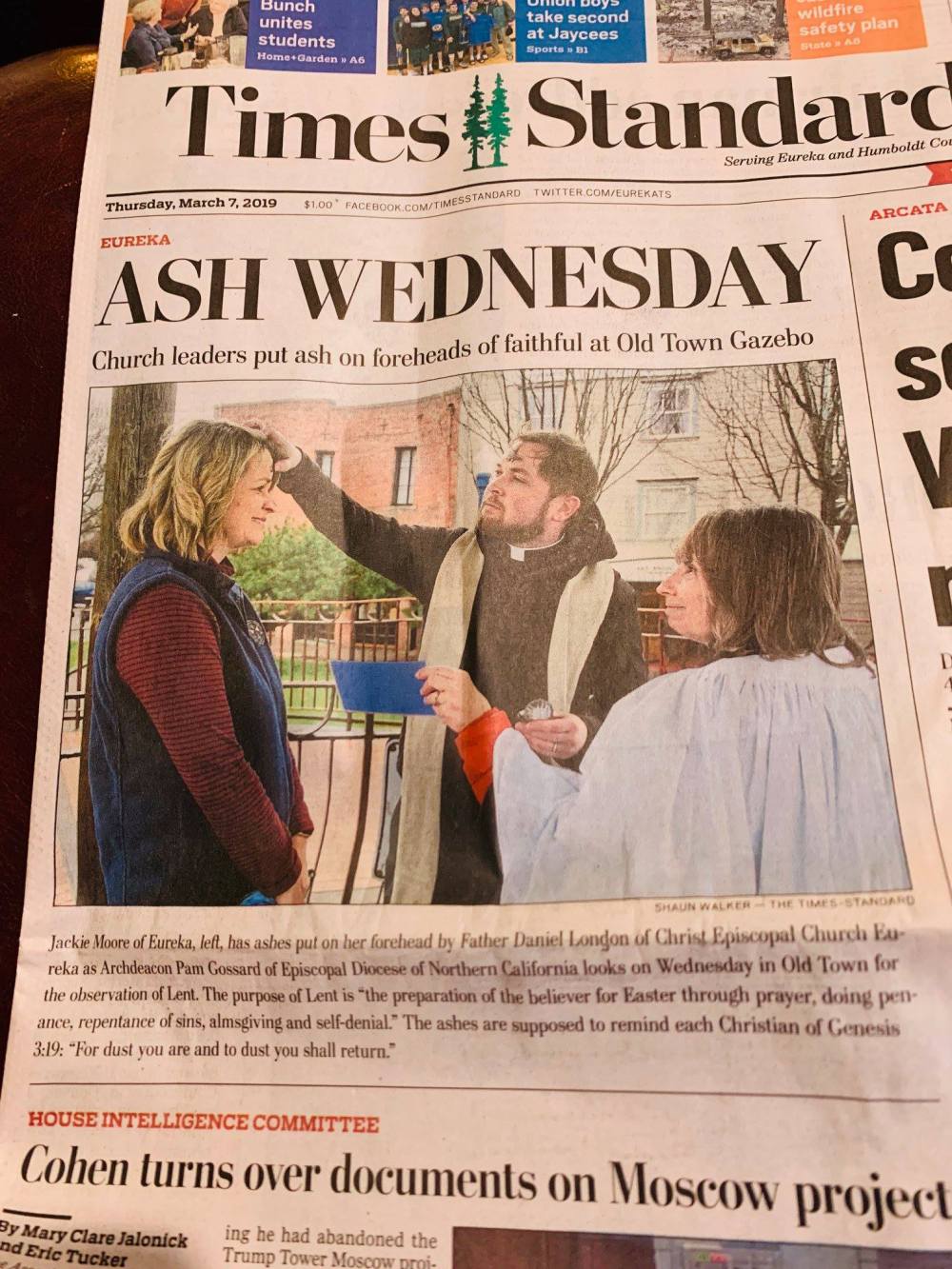
This homily was preached at Christ Episcopal Church in Eureka CA on Ash Wednesday, March 6, 2019.
It was Johannine scholar and Salesian priest Frank Moloney who first called my attention to the incongruity built into the Ash Wednesday service, in which we hear Jesus tell us, “Whenever you’re being pious, don’t make a show of it” and then we proceed to put ashes on our foreheads thus making a show of our piety, whether that is our intention or not. Frank Moloney did not try to resolve this tension but merely asked me to be aware of it. The awareness he invited me into was not of the fact that we as Christians so often fail to obey the teachings of Jesus, which we do. It was that our disobedience of Jesus, in some cases, is built into the very way we do church. For example, Jesus says, “Do not call anyone on earth ‘Father’” (Matt 23:9), and then we proceed to address some clergy often as Father. Jesus says, “Do not make vows” (Matt 5:34) and then we make vows at our baptism and at marriage. I’m certainly not opposed to calling someone “Father” or being called “Father;” I’m definitely not opposed to our baptismal vows (and marriage vows) and certainly not opposed to the imposition of ashes, but there is clearly a tension here. Jesus teaches us not to do something and, when we gather as his body on earth, in some cases, we do that very thing.
The Gospel reading for Ash Wednesday comes from a portion of the Sermon on the Mount, which begins in Matthew chapter 5 and concludes in chapter 7. Towards the beginning of the sermon, Jesus says something that, on the surface, seems to contradict what we just heard him say. We just heard Jesus say, “Don’t do your good deeds before others in order to be seen by them” (Matthew 6:1), but in Matthew 5, Jesus says, “You are the light of the world…let your light shine before others, so that they may see your good works” (Matt 5:16). Jesus seems to be contradicting himself within his own sermon. What’s going on here? We see incongruities not only between Jesus’s teachings and the way we do church, but we see them within Jesus’s teachings themselves, indeed within the very same sermon! So how do we approach this?
Apparent incongruities in Scripture are not simply mistakes or mere contradictions, but rather invitations to look more deeply into the paradoxical mysteries of God. In Paul’s letter to the church in Corinth, he doesn’t shirk at all from the paradoxes that have come to mark his life and ministry. He is very honest and upfront about them when he says, “We are treated as impostors, and yet are true; as unknown, and yet are well known; as dying, and see– we are alive…as sorrowful, yet always rejoicing; as poor, yet making many rich; as having nothing, and yet possessing everything.”
Lent is a season of prayerful and penitential preparation for the Feast of the Resurrection. And it is a long liminal space between Epiphany and Easter, that invites us to sit with the incongruities and allow them to open us up to receive the divine mysteries lurking underneath, and to appreciate the paradoxical mysteries that are all around us: We are dust, but we are dust that breathes the breath of God. We are mortals, but we have eternity in our hearts. And tonight we mark ourselves with the cross, the great coincidence of opposites, the symbol that represents the simultaneous glorification and humiliation of the One who was both God and man. We are presented (almost bombarded) with a plethora of paradoxes. And this year, I am personally confronted with the paradoxical tension of observing Ash Wednesday (when we meditate on our mortality) on my birthday.
I’m tempted to have us simply sit with these tensions as Frank Moloney did and let them challenge and transform us throughout this Lenten season. But instead I’m going to offer one invitation that can resolve some of these tensions and also help direct and guide us through this season of penance. The invitation is within our church’s mission statement: we at Christ Church Eureka seek to glorify God. We observe Lent to glorify God. We come to church to glorify God. We give. We pray. We fast in order to glorify God, in order to recognize and appreciate our utter dependence on God for every single breath we take, for every bite of bread we consume, for every single penny we receive.
Jesus says, “You are the light of the world…let your light shine before others, so that they may see your good works and…. give glory to your Father in heaven” (Matt 5:16). May others see our good works so that God may be glorified. Not us. God.
We put ashes on our foreheads to give glory to the God who has breathed life into the dust of our humanity. We don’t do it to be pious. We make baptismal vows and marriage vows to help us glorify God in our lives and in our relationships. We don’t call a priest “Father” to glorify the priest. We are confronted with yet another paradox here with the fact that I’m called “Father Daniel” even though I’m the age of many of your children and even grandchildren (!). A priest is treated only with special honor and respect insofar as he or she functions as a symbol of God, whom we seek to glorify. It is only by seeking God’s glory and not our own that we receive the heavenly reward, which is our participation in divine glory and love.
So this Lent, I invite us to ask ourselves: what can I do this season to glorify God? How can my prayer, fasting and giving bring more glory to God and less attention to my own piety?
And when people do notice your good works, don’t hide behind some false modesty or false humility. Let your light shine so that others may glorify God because that light shining through you is God. That light shining through you is God who wants to reveal his glory to the world through you, through your precious, unique and matchless self. Don’t let piety or pride or false humility snuff out the divine light that beams within you and points us all to God’s overwhelming glory. Amen.

 DANIEL DeFOREST LONDON