
Readings for the Twenty Third Sunday after Pentecost (Proper 25 Year B)
Jeremiah 31:7-9
Psalm 126
Hebrews 7:23-28
Mark 10:46-52
This sermon was preached at Christ Episcopal Church Eureka on Sunday October 28, 2018.
According to the 8th century English historian the Venerable Bede, the Church of England and the subsequent Anglican communion (of which we as Episcopalians are a part) all began in 6th century Rome when Pope Gregory the Great saw two men in the market place and asked his friend where they were from. His friend told him that they were “Angles” from England. Pope Gregory, who was a punny pope (a pope who enjoyed puns), responded by saying, “They’re not Angles, they’re angels” and then he took it upon himself to make sure that these angelic Angles heard the Gospel of Jesus Christ. He sent his Benedictine friend Augustine to Canterbury in England on a mission to found the Ecclesia Anglicana, which is Latin for the Church of England. That’s where we get the term “Anglican” from Eccleisa Anglicana. Over the last 1500 years, we Anglicans have evolved and grown to become a worldwide communion of 85 million members and, although we have much to celebrate as a communion, we know that we are indeed not angels. In 2010, a group of Anglican scholars and theologians wrote a book referring ironically to Pope Gregory’s words called “Not Angels but Anglicans.” I was reminded of this a couple Sundays ago when someone came in from off the streets to our 8 am service here and, during the Eucharistic prayer, exclaimed rather loudly, “You’re not angels, but have a good day anyway.” I think he said that soon after he heard me say that we were joining our voices with angels and archangels and all the company of heaven.
I share all of this because I’ve been thinking a lot about angels ever since the subject came up in one of my discipleship groups. I will be offering a class on angels during Advent on Tuesday nights from 5:30 to 7, before Compline; and the theme of angels will permeate and hover over our upcoming Advent and Christmas seasons here.
The book of Hebrews says, “Do not neglect to show hospitality to strangers, for by doing that some have entertained angels without knowing it” (Hebrews 13:2). Hospitality is one of our core values here and I appreciate how we welcome visitors generally with warmth and a welcome bag and an invitation to join us for refreshments. By doing this, we may indeed be welcoming and entertaining angels.
The Hebrew for “angels” is “malak” which literally means “messenger.” So an angel’s main job is to deliver messages from God to us. Perhaps that visitor from off the streets a couple Sundays ago was an angel with a message for us. Last Sunday, we had some other visitors here at the 8 AM service (who may have also been angels) and they had a message for us that came indirectly in the form of a question, during our forum discussion from 9:15 to 10. One of the visitors asked about the priestly order of Melchizedek. Remember we talked about the mysterious figure of Melchizedek last Sunday, a royal priest who served Abraham bread and wine and gave him a blessing. The visitor asked, “Who besides Jesus and Melchizedek are part of this royal priestly order?” I offered an initial answer and then, after thinking about it some more, I said, “Actually everyone who is baptized in the Name of the Father, the Son and the Holy Spirit is a royal priest in the order of Melchizedek.” If you have been baptized, you are a priest.
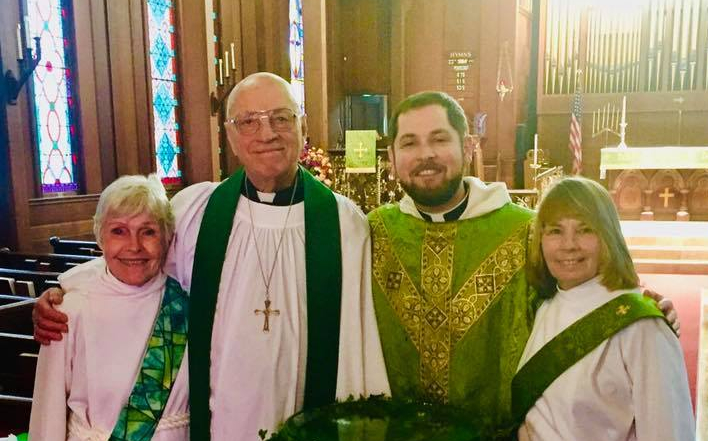
This is why the author of the book of Hebrews invites us to “approach the throne of grace with boldness” (Heb 4:16), which is something only the priest could do. In our reading this morning from Hebrews, the author explains that, because of Christ, we can approach God’s holy presence, with the boldness of blind Bartimaeus because “Christ is able for all time to save those who approach God through him, since he always lives to make intercession for [us].” (Heb 7:25) Through Christ, we are all priests, able to approach the awe-inspiring presence of God, where angels fear to tread. In his first Epistle, Peter says that we who are baptized are part of a “holy” (2:5) and “royal priesthood” (2:9), just like Melchizedek. The Book of Revelation explains that Christ has freed us from our sins by his blood to be “priests who serve God the Father” (Rev 1:5). So then, if we are all priests already, through Christ, by virtue of our baptism, why do we have ordained ministers? This is an important question for us consider on this day when we celebrate the new ministry of our new Associate Priest Fr. David Shewmaker.
Ordained priests, like Fr. Shewmaker and myself, are intended to function and serve as icons (sacramental images) of the common priesthood of all believers. Ordained priests derive their priesthood from the priesthood of the whole people and represent that priesthood to itself.[1] In fact, the sacramental priesthood is secondary to the common (or fundamental) priesthood we all share through Christ in our baptism. Furthermore, all of the ordained clergy (especially deacons and priests) are all icons of the diaconate and the priesthood of all believers. We are all deacons whenever we embody the servanthood of Christ and function as a bridge between the church and the world. And we are all priests whenever we work towards reconciliation, whenever we offer blessings and spiritual nourishment, and help restore all people to unity with God and each other and the earth.
The ordained clergy enact these roles in the liturgy partly in order to show the people what the Holy Spirit has empowered all of us to do in the world. And often the real work of outreach, reconciliation, hospitality, and peace-making is done not by clergy, but by the laity. One of the relatively recent spiritual successors of Augustine of Canterbury is William Temple who understood this when he wrote, “Nine-tenths of the work of the Church in the world is done by Christian people fulfilling responsibilities and performing tasks which in themselves are not part of the official system of the Church at all.”[2] Most of the time, according to William Temple, it is not the ordained clergy who are serving and functioning as deacons and priests in the world but the laity. And our country is in desperate need of deacons and priests like you all today, deacons and priests who are willing to courageously speak out and stand up for our brothers and sisters who remain vulnerable to horrific violence and hatred, like the hate crime that was committed in a Jewish synagogue in Pittsburgh just yesterday. Our Lord Jesus Christ understood the Holy Spirit as the Advocate who protects all victims of hatred and violence. If we have been baptized in the Name of the Holy Spirit, then we have been commissioned to advocate for and protect all who are vulnerable to violent scapegoating and victimization. If we have been baptized in the Name of the Holy Spirit, then we have been commissioned to be agents of healing and reconciliation, to be deacons and priests in the world.
Just as Deacons Pam and Anne invite us to discover our own unique calls to the diaconate so too do Fr. Shewmaker and I invite you to discover your own unique calls to the priesthood, to the royal priesthood of Melchizedek. For some, that might include a call to the ordained ministry, but remember that most people serving as deacons and priests in the world today, according to William Temple, are not ordained clergy but laity. A couple Sundays ago, one visitor functioned as an angel by delivering to us the divine message that we are not angels, but simply Anglicans. Last Sunday, another visitor functioned as an angel by delivering to us the divine message that we are all priests in the order of Melchizedek, called to work towards healing and reconciliation, to combat hatred and violence, to offer blessings and spiritual nourishment, and to help restore all people to unity with each other, with the earth, and with God. May it be so. Amen.
[1] L. William Countryman, Living on the Border of the Holy: Renewing the Priesthood of All (Harrisburg PA: Morehouse Publishing, 1999), 44.
[2] William Temple, Christianity and Social Order (New York: Penguin, 1942), 17.

 DANIEL DeFOREST LONDON