
Readings for the Twenty Second Sunday after Pentecost (Proper 24 Year B)
Isaiah 53:4-12
Psalm 91:9-16
Hebrews 5:1-10
Mark 10:35-45
This sermon was preached at Christ Episcopal Church Eureka on Sunday October 21, 2018.
Christ did not glorify himself in becoming a high priest, but was appointed by the one who said to him, “You are a priest forever, according to the order of Melchizedek.” (Hebrews 5:5-6)
Christ Church Eureka is unique for many reasons. One reason Christ Church Eureka is unique among Episcopal churches, at least in my experience, is that in our pew racks, alongside our prayer book and hymnal (which you’ll find in basically every Episcopal church), we also include a Bible. That is actually not very common. We Episcopalians (who are generally very well educated) are also not well known for our biblical literacy and knowledge. In fact, we’re kind of notoriously known for the opposite. You may have heard the joke about the Episcopal grandmother who finally decided to read the Bible from cover to cover. When she finished, she pulled the rector aside at coffee hour and confided, “I really enjoyed reading the Bible, but I was surprised how much it quotes the Book of Common Prayer!” I’ve heard other clergy joke about how surprisingly difficult it can be to find a Bible in an Episcopal Church. So I’m glad that we have several here. And we have the New Revised Standard Version, which is the official authorized translation for the Episcopal Church, a translation that tries to be as faithful as possible to the original Hebrew and Greek.
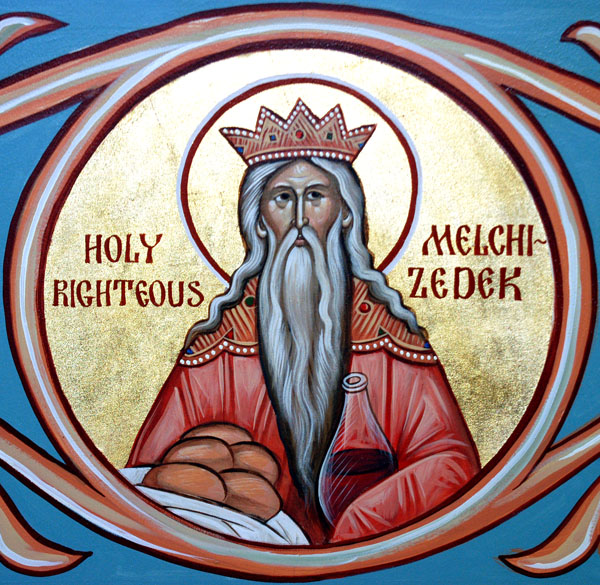
Last Sunday, I invited us to open our Prayer books to read about deacons. This Sunday, I invite us to open our Bibles to read about the first priest. The first priest mentioned in the Bible is Melchizedek, who was mentioned twice in our reading this morning from Hebrews and is actually a very mysterious figure, who is only mentioned twice in the entire Old Testament. The first reference to Melchizedek is in Genesis chapter 14, which I invite us to look at together. For those who don’t know, Genesis is the first book of the Bible. It is Greek for “Beginning” and it tells the story of creation, the flood, and the calling of Abraham, Isaac and Jacob. Genesis 14 is on page 11 of your pew Bibles and we will begin at verse 17, under the heading “Abram Blessed by Melchizedek.” Now Abram is the person who later became Abraham, the spiritual patriarch and progenitor of Judaism, Christianity and Islam, religions that have been called “Abrahamic.” For simplicity sake, we will refer to him as “Abraham” rather than “Abram.”
Verse 17: “After [Abraham’s] return from the defeat of Chedorlaomer and the kings who were with him, the king of Sodom went out to meet him at the Valley of Shaveh (that is, the King’s Valley). And King Melchizedek of Salem brought out bread and wine; he was priest of God Most High. He blessed him and said, ‘Blessed be Abra[ha]m by God Most High, maker of heaven and earth; and blessed be God Most High, who has delivered your enemies into your hand!’ And Abra[ha]m gave him one tenth of everything.” (14:17-20)
Abraham just returned from a battle with tribal kings who had threatened and attacked his nephew Lot. Abraham was taking action and risking his own safety and well-being by protecting and defending his family and others who were vulnerable and in danger. And God gave him victory. Abraham defeated his enemies and Abraham knew that his victory and success were not because of his own personal power or wisdom or military genius. Abraham knew that all of the victories and successes that he experienced in his life were because of God’s blessings and favor. Abraham understood himself to be primarily a recipient of God’s love, which kept him humble and grateful. And he expressed that humility and gratitude when he met with Melchizedek, a priest from Salem, which means “Place of Peace” and which later became “Jerusalem.”
Melchizedek, the Priest of Peace, served Abraham bread and wine and then gave him a blessing that reminded him again that it was God who gave him victory and success. Most people date Abraham to around 2,000 BC so here we see that priests have been serving bread and wine and offering blessings for about 4,000 years. We are part of a very ancient tradition.
There’s another ancient tradition expressed in this biblical passage that we continue to uphold here at Christ Church; and it is what Abraham does in response to receiving the bread and wine and blessing. What does he do? It says he gives one tenth of everything. He does what is called “tithing,” that is giving one tenth of one’s annual earnings to God. Tithing, as we see here, has been a spiritual practice for thousands of years. For thousands of year, tithing has been a tried-and-true way of expressing our gratitude to God for all that he has given us. Abraham gives one tenth of everything to Melchizedek so that Melchizedek can continue his mission of offering bread and wine and blessings to all people and can continue reminding people that all good gifts are given to us by God Most High.
For us Christians, Melchizedek is clearly a precursor, a foreshadowing of Jesus Christ, our Great High Priest. That is what our reading from Hebrews is all about. Jesus is our Great High Priest who offers his self-giving love to us in the consecrated bread and, in the words of the prophet Isaiah, “pours himself out” for us in the consecrated wine, here in this holy sanctuary, where the holy work of Melchizedek continues.
Through Christ, God Most High blesses each one of us; and through Christ, we bless God Most High by offering our thanks and praise. Just as Abraham gave thanks to God by tithing to Melchizedek, so are we invited to give a portion of our time and treasure and talent back to God (in a reasonable and responsible way), because it was God who gave it all to us in the first place.
So as we pray a blessing over our pledges (and produce) this morning, let us remember that we are participating in a 4,000-year-old tradition that flows all the way back to Abraham and Melchizedek, a tradition that reminds us to give in order to move deeper into the ever-giving flow of divine generosity, to give in order to help continue the mission of Melchizedek, the mission of glorifying God, serving all people through the power of the Holy Spirit, and following our great high priest Jesus Christ, a priest forever, according to the order of Melchizedek. Amen.

 DANIEL DeFOREST LONDON