
Readings for the Twenty First Sunday after Pentecost (Proper 23 Year B)
Amos 5:6-7, 10-15
Psalm 90:12-17
Hebrews 4:12-16
Mark 10:17-31
This sermon was preached at Christ Episcopal Church Eureka on Sunday October 14, 2018.
Lord, we pray that your grace may always precede and follow us, that we may continually be given to good works; through Jesus Christ our Lord, who lives and reigns with you and the Holy Spirit, one God, now and for ever. Amen.
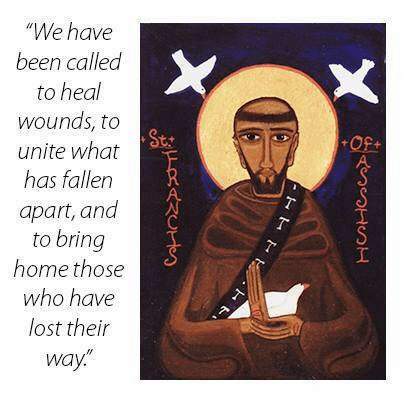
Last Sunday, 4 cats, 16 dogs and 112 human beings gathered here to celebrate the feast day of the church’s most beloved saint, St. Francis of Assisi. I spoke on the saint’s profound empathy for all creatures and all of creation. I explained St. Francis was a master of empathy because he sought to emulate the greatest Teacher of empathy, Jesus Christ, who according to this morning’s reading from Hebrews is our “high priest…who is able to sympathize/empathize with our weaknesses” because “he had been tested in every respect as we are” (Heb 4:15). Part of the reason that God became incarnate among us was to empathize with us.
Anglican Bishop Mark Santer said, “Of all the saints, the one whom people find most Christlike is St. Francis.” I believe this is partly because of the saint’s empathy, but also because of another quality that the saint exhibited and that is his radical commitment to being a servant.
As a wealthy boy, young Giovanni (nicknamed Francis) wanted to serve his hometown of Assisi by training as a knight and fighting in the war between Assisi and the neighboring town of Perugia, where he eventually became a prisoner of war. After being released, he returned home to Assisi, disillusioned and traumatized and depressed. As the story goes, it was during this time that he heard this morning’s Gospel teaching in which Jesus says to a young man, “Go, sell what you own, and give money to the poor, and you will have treasure in heaven; then come, follow me” (Mark 10:21). Francis heard Jesus speaking these words directly to him. Although his wealthy father Pietro Bernardone, a wealthy cloth-merchant in Assisi, told his son that such teachings are meant to be interpreted figuratively, Francis insisted that he obey these words literally. And much to his father’s dismay, Francis sold all of his belongings including his own clothes and ended up standing naked in the middle of Assisi, declaring his desire to serve only his Father in heaven.
The local bishop (Guido II) saw Francis and covered him with his robe and brought him into the church’s fold. Soon after that, the Pope (Pope Innocent III) gave Francis his blessing and gave him permission to found a religious Order of brothers committed to taking this morning’s Gospel teaching literally and devoting themselves to serving only their heavenly Father. Francis became a friar. He never became a priest or a bishop. He didn’t feel that those clerical orders would help him emulate Christ. However, because of his radical commitment to being a servant and embodying the servanthood of Jesus, Francis was ordained to another clerical order, the same order to which Pam and Anne were ordained: the permanent diaconate. St. Francis was a deacon. Most of us don’t think of St. Francis as a deacon. I guess his sainthood tends to overshadow that a bit. But today, the Catholic Church recognizes St. Francis on their liturgical calendar as a deacon. And although historians debate this, it is clear that St. Francis embodies the true meaning of diakonia, which is Greek for service; service to the heavenly Father expressed in service to all people through the power of the Holy Spirit, all people, particularly the poor, the weak, the sick and the lonely.
Again, Anglican Bishop Mark Santer said, “Of all the saints, the one whom people find most Christlike is St. Francis.” He continues by saying, “It is significant that Francis was never ordained a priest, but was an ordained deacon, a servant, to the end of his life.”
As a deacon, St. Francis preached the Gospel, but he preached more with his actions than with his words. He was known to have said, “Preach the Gospel always, use words only when necessary.” His life was his sermon and his life was the answer to the prayer that we prayed in this morning’s Collect that “grace may always precede and follow, that we may continually be given to good works.”
Today, I want to recognize and appreciate the ordained deacons in this community: Pam Gossard and Anne Pierson. Two women who, like St. Francis, heard and responded to Christ’s call to serve their heavenly Father by serving all people through the power of the Holy Spirit. If you open your prayer books to page 543 (which I invite you to do), you will see the job description of a deacon.
The second paragraph reads, “As a deacon in the Church, [they] are to study the Holy Scriptures, to seek nourishment from them, and to model [their lives] upon them. [They] are to make Christ and his redemptive love known, by word and example, to those among whom [they] live, and work, and worship. [They] are to interpret to the Church the needs, concerns, and hopes of the world. [They] are to assist the bishop and priests in public worship and in the ministration of God’s Word and Sacraments, and [they] are to carry out other duties assigned to [them] from time to time. At all times, [their] life and teaching are to show Christ’s people that in serving the helpless they are serving Christ himself.” Deacons Anne and Pam have made vows to be consistently nourished and formed by Holy Scripture, to make Christ’s love known among us, and to keep reminding us of the needs, concerns and hopes of the world outside these doors. We are so blessed to have these deacons among us, these women who share the same clerical order of the church’s most beloved saint, St. Francis.
Another crucial part of the ordained deacon’s job is to remind all the baptized members of the Body of Christ of our call to be deacons. If you look at the first paragraph on page 543, you will read that “every Christian is called to follow Jesus Christ, serving God the Father through the power of the Holy Spirit.” It actually sounds very similar to our church’s new mission statement, doesn’t it? The ordained deacons serve as icons for the ministry of servanthood to which we have all been called through our baptism. In the Name of Jesus Christ, we have been called “to serve all people, particularly the poor, the weak, the sick, and the lonely.” This is why it so appropriate that our deacons dismiss us all to the world outside these doors by saying the words of our mission, “Go in peace to glorify God, follow Jesus Christ, and serve all people through the power of the Holy Spirit. Alleluia.” The deacons remind us of our commitment to take Jesus seriously and sometimes even literally and to emulate the most Christlike of all the saints, St. Francis the Deacon, by discovering our own unique call to the diakonia.
I want to conclude by praying for our two deacons a prayer inspired by the words of St. Francis the Deacon. I invite them to join me on the chancel and I invite you all to pray this prayer with me.
Almighty, eternal, just, and merciful God,[1] yours alone are the praises, the glory, the honor, and all blessings.[2] We give you thanks for your beloved servants, Pam and Anne, for the beautiful ways that they make Christ’s love and sublime humility[3] known among us. We ask for your special blessings upon them both. May they live always in truth[4] as they seek nourishment from your Word. May they give us light[5] as they interpret the needs, hopes, and concerns of the world. Like Brother Fire and Sister Water, keep them playful, humble, robust and strong,[6] as they serve the poor, the sick and the lonely. Make them instruments of your peace. Where there is hatred, let them sow love.[7] May grace precede and follow them as they are continually given to good works; and may they help us all discover and live into our own unique calls to the diaconate. May they help us hold back nothing of ourselves for ourselves so that you who give yourself totally to us may receive us totally,[8] you who live and reign with the Son and the Holy Spirit in perfect Unity[9], all-powerful, holy, praiseworthy and blessed throughout endless ages. Amen.[10]
[1] A Letter to the Entire Order v. 50, Francis, 61.
[2] The Canticle of Brother Sun v. 1, Francis, 38.
[3] A Letter to the Entire Order v. 27, Francis, 58
[4] The Canticle of Exhortation to Saint Clare and Her Sisters v. 2, Francis, 40.
[5] The Canticle of Brother Sun v. 3, Francis, 38.
[6] The Canticle of Brother Sun v. 7-8, Francis, 39.
[7] The Prayer of St. Francis. This prayer was not actually written by St. Francis, but was anonymously penned in the early 20th century. However, it certainly encompasses the spirit of the saint.
[8] A Letter to the Entire Order v. 29, Francis, 58.
[9] A Letter to the Entire Order v. 52, Francis, 61.
[10] The Second Version of the Letter to the Faithful v. 62, Francis, 71.

 DANIEL DeFOREST LONDON
One thought on “St. Francis the Deacon”