
Readings for the Fourteenth Sunday after Pentecost (Proper 16)
Readings for the Fourteenth Sunday after Pentecost (Proper 16)– Track 2
Joshua 24:1-2a,14-18
Psalm 34:15-22
Ephesians 6:10-20
John 6:56-69
This sermon was preached at Christ Episcopal Church in Eureka CA on August 26, 2018.
Last Sunday, I preached on the life and death and witness of a young Episcopalian named Jonathan Myrick Daniels who understood in his “bones and sinews” the divine wisdom of self-giving love. He understood this wisdom through the sacraments of baptism and Eucharist, through which God communicates and offers his love to his people so that we can embody that love to the rest of the world.
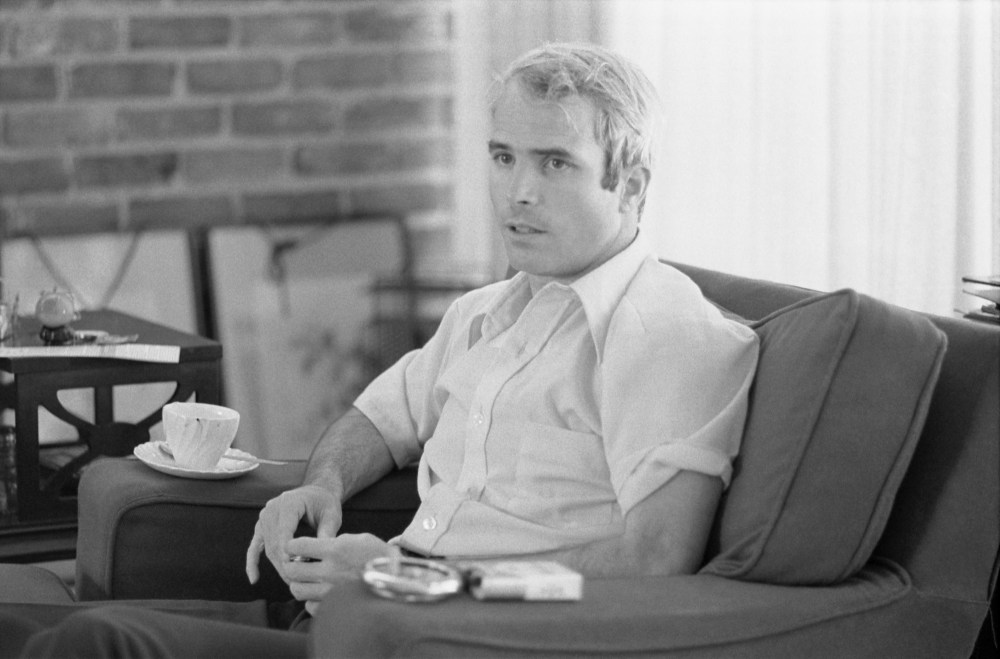
Today, I want to begin by reflecting briefly on the life and death of an older Episcopalian who also understood in his bones and sinews the divine wisdom of self-giving love. One doesn’t have to agree with his politics to acknowledge and respect the sacrifices made by the late John McCain, who died yesterday afternoon. While putting his life at risk to serve the country he loved, McCain was shot in the Vietnam War and captured by the North Vietnamese, who held him in a POW camp for 5 and a half years. As a prisoner of war, McCain was tortured and had no access to the military weapons and resources that he had previously wielded with considerable skill. Instead of giving into despair, he chose to start equipping himself with the armor of God. Remembering the faith of his fathers, including his great grandfather who was an Episcopal priest, he began recalling all the words of the Episcopal liturgy, many of which we say together in our worship service this morning. He began praying in the Spirit at all times in supplication. He said he prayed more frequently and fervently than ever before. He even began sharing his faith with the guards. Like St. Paul, he was “an ambassador in chains.” And he armed himself with the sword of the Spirit, which is the Word of God, as he brought to mind the teachings of Jesus, which Simon Peter, in our Gospel this morning, calls “the words of eternal life.” McCain may have even recalled the words of this morning’s Psalm: “Many are the troubles of the righteous, but the LORD will deliver him out of them all.”
Eventually, John McCain was delivered and released from the POW camp. In fact, he was offered an early release because he was the son of an admiral, but he refused to be released until all the other prisoners were released. And when he was released, he had to deal with permanent physical disability. Throughout his life, he continued to put on the armor of God by praying for righteousness, peace and truth. And he continued to wield the sword of the Spirit, which is the Word of God. However, he also began to notice that many Christians and many Christian leaders were waving this Sword of the Spirit around very clumsily and dangerously. He saw that the Word of God was being used to encourage intolerance and sometimes to hurt innocent people. Occasionally, when he spoke out against this abuse of Scripture, he would lose some political support from religious fundamentalists on the far right. He sometimes offended people with his words, not too unlike Jesus in the Gospel of John, which has been called the Maverick Gospel.[1] Again, one does not have to agree with his politics to respect him, a fellow Episcopalian who was formed and guided by many of the same prayers we pray together today.
I personally admire the late John McCain and I am challenged by his critique of religious leaders who seem to misuse the Word of God. When St. Paul illustrates the armor of God, most of the equipment he describes is equipment used for defense (breastplate, helmet, shield), except for the sword. Paul understood that the Word of God can indeed be very dangerous when placed in the wrong hands, just like a sword. History has shown how the words of Scripture (including the words of Christ) have been misconstrued to justify hate, violence, and oppression. The Bible has been used as a weapon of mass discrimination. And yet we also believe that the words of Scripture (and the words of Christ) are indeed the words of eternal life.
Franciscan priest and theologian Richard Rohr said, “The scriptures are the best book in the world, and maybe also the worst. They are the worst when they are used for bullying and self-satisfaction, and the best when used for the healing of the world and the transformation of the self. Obviously God intended the second.”
When it comes to some of the challenging teachings of Christ, I can sympathize with the disciples in the Gospels who are simultaneously offended and fascinated (just as I feel simultaneously offended and fascinated by many other parts of Scripture). When it comes to the Gospel of John, I am personally comforted by the words of one of the great Anglican commentators on John’s Gospel, Sir Edwyn Hoskyns, who said, “[You] will not be true to the book [of John] if, at the end [of much reading and studying], the gospel does not still remain strange, restless and unfamiliar.”[2]
Jesus is strange when he says “eat my flesh” and “drink my blood” and “whoever eats me will live.” That should initially sound strange to us. And yet don’t we also have this sense that he is offering us something eternal and life-giving and nourishing? Don’t we have this sense he’s not telling his disciples to become cannibals, as the Romans once considered the early Christians to be? Don’t we have this sense that Jesus is attempting to describe a radical intimacy that really cannot be described with simple language? That Christ is coming up against the limits of our language and pushes against it walls with outrageous hyperbole and metaphor so that what appears to be opacity is really poetry pointing to an overwhelming divine love? I think many of us, like the disciples, have that sense when we hear these words of Jesus. And really only he can offer what we are looking for.
I’m sure I will spend a life time peeling away at the layers of meaning in Jesus’s strange and yet life-giving words. The few layers I have started to uncover in Jesus’s Bread of Life discourse have helped me to understand and appreciate the wisdom of self-giving love, which I see expressed in Jonathan Myrick Daniels and in John McCain.
Last Sunday, I introduced us all to the Bread of the Presence or the Showbread, which was used in the ancient Jewish temple. I have found this to be very helpful in understanding Jesus’s Bread of Life discourse. According to the book of Leviticus, the Jewish high priests kept twelve loaves of bread in the ancient temple, in the presence of God. Three times a year at the major pilgrimage festivals of Passover, Pentecost and Sukkot, the priests would bring the bread out of the temple and show it to the people, lift it up, and say, “Behold, God’s love for you.” This Bread of the Presence symbolized God’s love for God’s people. The bread was then consumed by the priests, and only the priests; and by consuming this bread, the priests received wisdom and insight. The bread imparted life-giving wisdom. And with this wisdom, the priests understood the deeper meaning behind the entire temple and it rituals, including all of the bloody animal sacrifices that many of us might find disturbing today. They understood that the complex sacrificial system of the Jewish temple was not really about sacrificing animals in order to appease a bloodthirsty god. Instead, according to this high priestly wisdom, the blood of the sacrificed animals symbolized and embodied the blood of God who pours out his life and love for his people, every day. The high priests understood that the temple was all about God trying to communicate and offer his self-giving love to his people in a way that nourished and transformed them so that they could embody God’s love to the rest of the world. That was the high priestly wisdom.
And when Jesus fed the five thousand with the new Bread of the Presence, he was extending the high priesthood and the high priestly wisdom beyond the temple and empowering thousands of people to be high priests and to embody the self-giving love of God in the world.
And that is the wisdom imparted to all of us through the consecrated bread and wine that is the flesh and blood of Christ. With that wisdom, we can emulate the love of Christ and the heroic and courageous acts of Daniels and McCain and effectively wield the sword of the Spirit for the healing of the world.
[1] Robert Kysar, John the Maverick Gospel (Louisville KY: Westminster John Knox Press, 2018).
[2] Sir Edwyn Hoskyns, The Fourth Gospel, ed F. N. Davey (London: Faber and Faber Limited, 1947), 20.

 DANIEL DeFOREST LONDON