
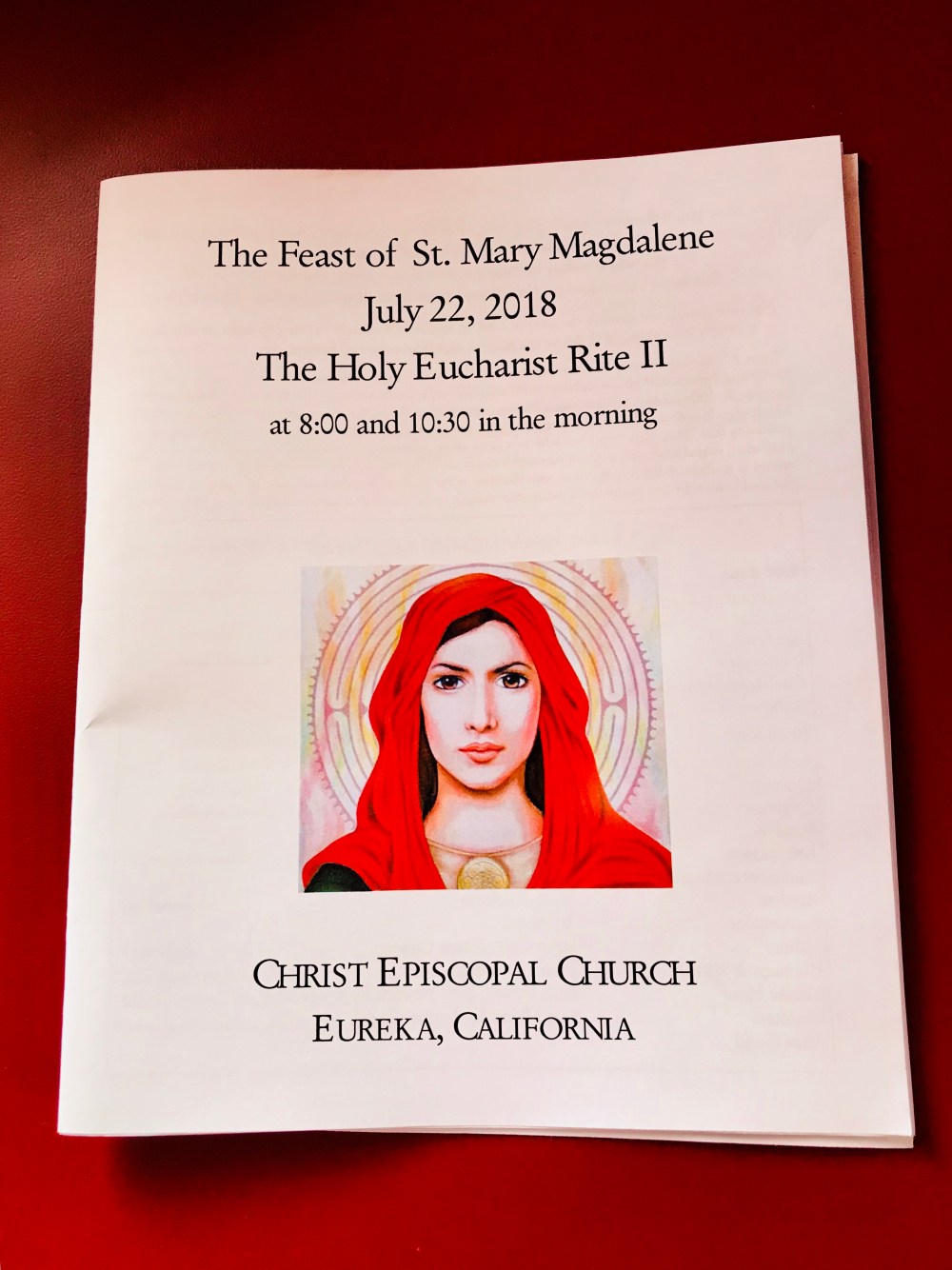
As many of you already know, I have been drawn to the spirituality of Christian mystics, especially Christian female mystics. I have taught courses on Christian female mystics such as the German Hildegard of Bingen, the Spanish Teresa of Avila, and my personal favorite, the English Julian of Norwich. A mystic is someone who has had a profound experience of union with God and then lived to talk about it; and today is the feast day of one who might be considered the mother of all female mystics (Christian and Jewish): namely, Mary Magdalene.
Now I honestly did not give her too much thought throughout my graduate studies because of all the commercial hype and hullabaloo often associated with her. Books like Holy Blood Holy Grail and The Da Vinci Code tantalizingly suggest that she married Jesus and bore his child, whom she brought to France. Their supposed daughter Sarah carried on the royal blood of Christ, which apparently gave rise to the Merovingian dynasty. In Old French, this royal blood of Christ was called the “sang real.” Over time, this phrase was misread or miswritten as “san greal,” which means “Holy Grail.” So the argument is that the true “Holy Grail” was actually the royal blood. Now all of this pseudo-history about Mary Magdalene certainly tickles the imagination (and there is much more), but I don’t think Mary needs all of these extra-biblical accretions to demand our attention and appreciation and respect.
The New Testament clearly sees her as the first woman apostle if not the first apostle altogether. She was the first to encounter the Risen Christ, who then sent her (apostello) to the disciples to share her Easter experience of the Resurrection, making her the “Apostle to the Apostles.” Curiously, she does not show up at all in the Book of Acts or in any of Paul’s Epistles, which makes many scholars wonder if the early male leaders of the church were suppressing her witness and apostolic authority.
Over the centuries, church leaders continued to downplay her apostolic status and underscore her identity as a penitent prostitute, while simultaneously praising the perpetual virginity of Mary, the mother of Jesus, as the ideal woman for females to emulate. The truth is that Mary Magdalene is never once called a prostitute in the New Testament. According to the Gospel of Luke, she had been exorcised of seven demons, but this does not necessarily refer to the seven deadly sins or a lust-filled past, as church fathers like Pope Gregory the Great suggest. Instead, according to theologian Jean-Yves Leloup, this means that she has “done her psychological work,” that hard but necessary inner work that most of us need to do, at one point or another in our lives.[1] So according to the New Testament, Mary Magdalene was not a demon-possessed prostitute; but actually a psychologically mature Apostle to the Apostles.
The Gospel reading for the feast day of Mary Magdalene recounts Mary’s recognition of Jesus in the garden, early in the morning, while it was still dark. This reading oozes with nuptial references, recalling the encounter between the first man and woman in the garden of creation (Gen 2) as well as passages from the Song of Songs that link the garden with sensuality and spices: “I come to my garden…I gather my myrrh with my spice…eat, friends, drink and be drunk with love” (5:1). Song of Songs should really be read as the soundtrack to this garden scene in John’s Gospel. We can easily imagine Mary Magdalene saying, “All night I lay on my bed; I searched for the one my heart loves. I searched for him. I will arise now and go about the city, among its streets and squares I will search. I will search for the one my heart loves…for love is as strong as death.”[2] With all of this passion welling up within her, we can also imagine Mary wanting to embrace Jesus when she recognizes him in the garden. However, Jesus tells her not to do the one thing that her whole body is screaming to do. He says to her, “Do not touch me.” Noli me tangere.
Our translation interprets Jesus’s words as “Do not hold on to me,” which suggests that Mary Magdalene can’t stop hugging her beloved Jesus, but the Greek verb is hapto, which clearly means “touch.” So I’ll ask again today the same question I asked on Easter Sunday: Why does Jesus tell Mary not to touch him? I hear an answer to this question in Christ’s commission to Mary to “Go to my brothers” (20:17). Jesus is telling Mary that if she wants to touch his body she is now invited to do so among the community of believers, which, after Easter, is understood to be the Body of Christ. This is why it makes sense for Jesus to invite Thomas to touch his flesh in the same chapter (verse 20:27) because he is among the community of disciples, surrounded by the Body of Christ.
We are all invited to touch and physically encounter the Body of Christ in this very gathering, among those with whom we serve and worship. We are invited to experience the Body of Christ with our senses, in the Eucharist when we taste Christ’s flesh. In fact, we are invited to touch the Body of Christ through all the seven sacraments, which use the earthly elements of water, wine, oil, bread and human bodies as vessels for divine encounter, as conduits for physical intimacy with the Risen Christ.
One way that I like to remember the seven sacraments is with the acronym “BECOMES” (because a person becomes a part of Christ’s Body through the sacraments). The “B” stands for Baptism, the “E” for Eucharist, the “C” for Confirmation, the “O” for Ordination, the “M” for Marriage, the second “E” for Extreme Unction (Last Rites), and the “S” for Shriving, which is an old English way of saying confession. All of these are ways that we can touch and be touched by the Risen Christ. And one of these seven sacraments may likely have roots in the ministry of Mary Magdalene herself; and that is the sacrament of unction, of holy anointing. New Testament scholar Bruce Chilton suggests that Jesus and Mary Magdalene may have shared a common ministry of ritual anointing, which he describes as a Hellenistic and Jewish shamanic practice.[3] We have a record of Jesus engaging in this practice of anointing when he makes an ointment from his own saliva and then anoints and heals a blind man (in Mark 7:33 and John 9:6). When Mary anoints Jesus’s feet with expensive perfume in the town of Bethany, Jesus points out that “she bought it so that she might keep it for the day of [his] burial” (John 12:7). So when Mary Magdalene shows up at the tomb in the Gospel of John, asking the “gardener” for Jesus’s body, she was likely planning to anoint him then too. Episcopal priest and contemplative author Cynthia Bourgeault points out that the Passion of Christ is therefore framed “around these two parallel anointings—at Bethany and in the garden of the resurrection.”[4] And in her book on Mary Magdalene (which I recommend), Cynthia Bourgeault strongly encourages the church to offer anointing for healing much more frequently and intentionally.
So today, in honor of this mother of female mystics, I invite us to participate in this sacrament of holy unction, so that we may be, in the words of today’s Collect, “healed from all our infirmities” and restored to “health of body and of mind.” In this way, we can touch and be touched by the Risen Christ who is among us right now, and we can see more clearly Christ (the “Anointed One”) in each other. During communion, after you have received the Body and Blood of Christ, you are invited to remain at the altar rail to receive anointing with holy oil in the name of the Triune God: the Father, the Holy Spirit and the Son who restored Mary Magdalene to health of body and of mind, and called her to be a mighty witness of his resurrection so that we can all experience the Risen Christ among us here and now. Amen.
[1] In fact, there’s an ancient text called The Gospel of Mary Magdalene that traces Mary’s progress through seven stages of spiritual purification thus supporting this interpretation. Jean-Yves Leloup, The Gospel of Mary Magdalene (Rochester VT: Inner Traditions, 2002), 106-9
[2] Song of Songs 3:1-4 and 8:6-7. Cynthia Bourgeault placed these words in the mouth of Mary Magdalene in a libretto she wrote. Borgueault, 209.
[3] Bruce Chilton, Mary Magdalene: A Biography (New York: Doubleday / Image, 2005), 63.
[4] Cynthia Bourgeault, The Meaning of Mary Magdalene: Discovering the Woman at the Heart of Christianity (Boston: Shambhala, 2010), 208.

 DANIEL DeFOREST LONDON