
Readings for Good Shepherd Sunday (the Fourth Sunday of Easter – Year B)
This sermon was preached at Christ Episcopal Church Eureka on Sunday April 22, 2018.
In 1940, Anglican author and apologist C.S. Lewis wrote a book titled The Problem of Pain, which addresses the question of suffering: How do we reconcile an all-loving and all-powerful God with a world of suffering? Lewis offers an intellectual defense of God’s justice and righteousness in the midst of suffering. The theological term for this defense of God, this attempt to answer the problem of evil is theodicy (which means God’s righteousness). Lewis and many other theologians have articulated several philosophical theodicies throughout the centuries. However, Lewis revisits this question of suffering twenty years later after losing his beloved wife to cancer. In his later book A Grief Observed, he vents and explores his grief and, although he already understands the righteousness of God intellectually, he struggles to understand God’s righteousness emotionally and spiritually. He boldly accuses God of being a “Cosmic Sadist” (49) and seriously wonders whether God is a veterinarian or a vivisector (46). He brings these audacious questions to God in prayer and instead of receiving philosophical arguments that reaffirm his belief in God’s righteousness, he experiences God’s pastoral response to his questions which invite him to experience God as a good and loving Shepherd. He experiences a pastoral theodicy.
In today’s Gospel, Jesus describes himself as the Good Shepherd. However, he does not say this out of nowhere. He says this in response to a question that his disciples ask. And their question is about the origin and cause of suffering. In the previous chapter, Jesus and his disciples walk by a man blind from birth and the disciples ask their rabbi, “Who sinned this man or his parents that he was born blind?” cAlthough their question is severely limited by their cultural understanding of illness and infirmity, they are essentially asking Jesus, “Why is there suffering here? What is the cause?”
If any of us had the chance to sit and have a meal with Jesus, I am sure that many of us would want to ask him about suffering, in one way or another, “Why do you allow it? Why is the world set up this way? Why me? Why them?” In the Gospel of John, Jesus is most clearly divine, and so here we have the disciples asking the divine Christ to explain to them the origin of suffering. The response is worth paying attention to. During Lent, some of us explored Christ’s direct answer to this question in some depth. Christ invites them out of their finite and limited categories of understanding and encourages them to see suffering not as the result of sin but rather as an urgent call for them to bring healing wherever and however we can. Jesus then punctuates his response by miraculously healing the blind man. After a kerfuffle with the religious authorities, Jesus then launches into the Good Shepherd discourse, inviting his listeners to experience him as a caring Pastor, not necessarily providing all the answers but being present in the midst of difficulty, frustration, confusion and pain. Jesus does not offer a philosophical theodicy but invites his listeners to experience a pastoral theodicy, to experience God’s pastoral response to their struggle and their questions.
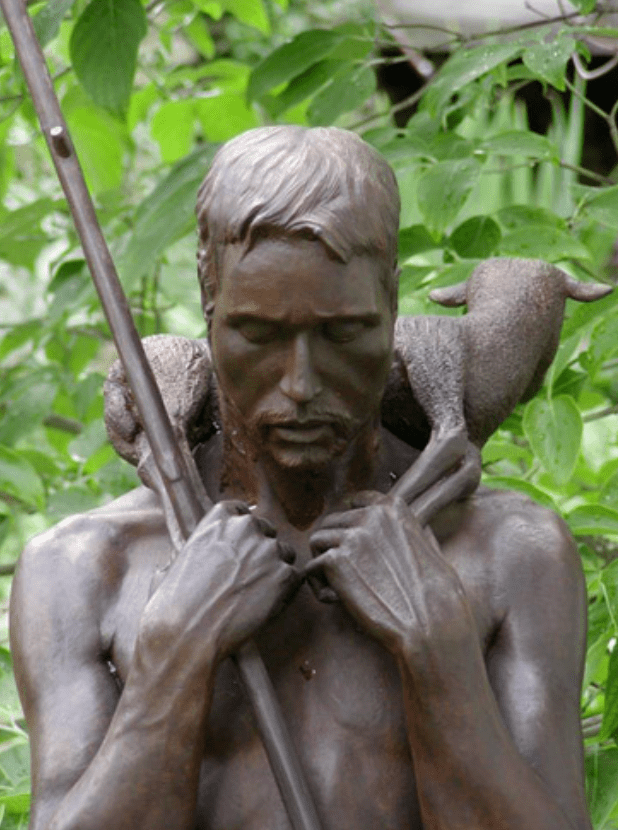
We get the word “pastor” from the word “shepherd,” an image used throughout scripture to describe God’s care for God’s people. The most famous use of the shepherd image is of course Psalm 23, a psalm which emphasizes God’s pastoral presence in the midst of suffering and confusion: “Though I walk through the valley of the shadow of death I shall fear no evil; for you are with me; your rod and your staff, they comfort me.” Jesus reiterates this pastoral presence in the midst of danger when he describes the hired hand who runs away as soon as he sees the wolf coming. The Good Shepherd, on the other hand, remains present in the face of danger and distress. The Good Shepherd protects his flock from the violence of the wolf, even if that means laying down his life, and even if that means taking the blame for the violence.
The disciples asked Jesus a question about suffering and instead of receiving a philosophical defense of God’s righteousness; they receive a pastoral theodicy, an invitation to experience the pastoral presence of the Good Shepherd in the midst of suffering and confusion. Several years later, the disciples show this same pastoral presence to a man born lame by healing him and then inviting him and the onlookers to experience Christ as the Good Shepherd who laid down his life for his sheep, the Good Shepherd who received the violence of the wolves and then transformed it through his forgiveness.
The invitation to us in these readings is to be a pastoral presence to one another in the midst of difficulty and distress, in the presence of violent wolves and even in the shadow of death. When I was a chaplain at the San Francisco General Hospital, my supervisor encouraged us to practice a “non-judgmental ministry of presence.” In order to do this, he said that we needed to travel the longest journey that a person ever takes, which is only 18 inches, from the head to the heart. When we confronted suffering in the hospital patients, some of us were inclined to offer them our philosophical theodicies. We quickly realized how impotent these were in the face of lifelong sickness, severe mental illness and impending death. They could offer no comfort to those who were ill or to family members who were experiencing loss. They needed a theodicy that spoke to their heart, not to their head. They needed a pastoral theodicy that listened to their questions and frustrations, not a philosophical theodicy that fed them unhelpful answers.
The invitation in these readings is, in the words of First John, to “love, not in word or speech, but in truth and action.” To love not by philosophizing but by remaining present in the face of struggle, even to the point of laying down our lives for one another.
I will admit that this is tricky and requires discernment. We are not called to be doormats or masochists or even emotional martyrs. Like the disciples, we learn best how to be a pastoral presence to one another by experiencing the pastoral presence of our divine Good Shepherd. We can do this by bringing our questions and frustrations about suffering to God in prayer and to expect a divine pastoral response, not a philosophical argument but a pastoral response that comforts us and forms us to be an effective pastoral presence to one another.
Towards the end of his book A Grief Observed, C.S. Lewis wrote, “When I lay these questions [of suffering] before God I get no answer. But a rather special sort of ‘No answer.’ It is not the locked door. It is more like a silent, certainly not uncompassionate, gaze. As though He shook His head not in refusal but waiving the question. Like, ‘Peace, child; you don’t understand’” (80). Lewis experienced a pastoral theodicy and in the process began to realize the impotence of his philosophical theodicies. He then wrote, “Can a mortal ask questions which God finds unanswerable? Quite easily, I should think. All nonsense questions are unanswerable. How many hours are there in a mile? Is yellow square or round? Probably half the questions we ask — half our great theological and metaphysical problems — are like that” (81).
By abiding in the Good Shepherd, we can learn to let go of our need to box in and contain God within our finite boundaries. We can learn to deal with the fear and confusion that is underneath our questions and bring that fear and confusion to God in prayer no matter how violent or wolf-like they might be. The Good Shepherd remains present even when we are the wolves. The Good Shepherd responds pastorally to our fear, anger and violence and transforms us through his love and forgiveness so that we might be that same self-giving and pastoral presence to one another. So that even as we walk through the valley of the shadow of death, we may fear no evil, for the pastoral presence of the Good Shepherd is with us, always. Amen.

 DANIEL DeFOREST LONDON