
Apart from last Sunday’s serpentine detour, the readings from the Hebrew Scriptures this Lenten season have focused on holy contracts between God and humanity, which we call covenants. We get the word “covenant” from the Latin convenire, which means “agreement”; and these covenants are essentially Letters of Agreement in which God agrees to deliver on his promises of protection and providence while humanity agrees to trust and obey God.
Two Sundays ago, the Mosaic covenant urged us to be wary of the green-eyed monster of jealousy and to obey the most frequent command in the entire Bible: praise the Lord, give thanks, practice gratitude. We combat jealousy by regularly giving thanks, specifically through our frequent celebrations of the Eucharist, which means “Thanksgiving.” Last week, I celebrated the Eucharist four times with members of this community. Also this last week, I travelled down to Sacramento for a meeting with the bishop, and I told someone in the bishop’s office that I thought Christ Church Eureka was the most beautiful church in Humboldt county. The person responded by saying, “Actually, I think Christ Church Eureka is the most beautiful church in the diocese.” While our sacred spaces are not in competition, I still think it’s a good and joyful thing for us to give thanks for this beautiful sacred space and for all of those who help make this church so beautiful.
On the second Sunday of Lent, the Abrahamic covenant reminded us that there is a wideness to God’s mercy, wide enough to include all those who claim to be spiritual children of Abraham, especially our Jewish brothers and sisters. We have been participating in God’s wide and inclusive mercy by continuing to partner with the Eureka Interfaith Fellowship, the Betty Kwan Chinn Outreach Center, The Forgotten Initiative and many others. In fact, Peg Gardner and I recently calculated that, as a church, we serve about 600 people each month, inviting them all to experience God’s mercy and blessings, as promised in the Abrahamic covenant.
And way back on the First Sunday of Lent, the Noahic covenant reminded us of God’s love for all living creatures and invited us to tame our own wild beasts, our own inner lions. Thanks to the leadership of Lynne Bean and Byrd Lochtie, we responded to this invitation by starting an important conversation, last Sunday, on how we as a community and individuals can start taming the wild beast of lethal gun violence that has been hounding our country. I look forward to our conversation continuing and broadening and deepening.
It’s been exciting to see how we, as a church, have been responding to the invitations and claiming the blessings of these powerful biblical covenants throughout this season of Lent.
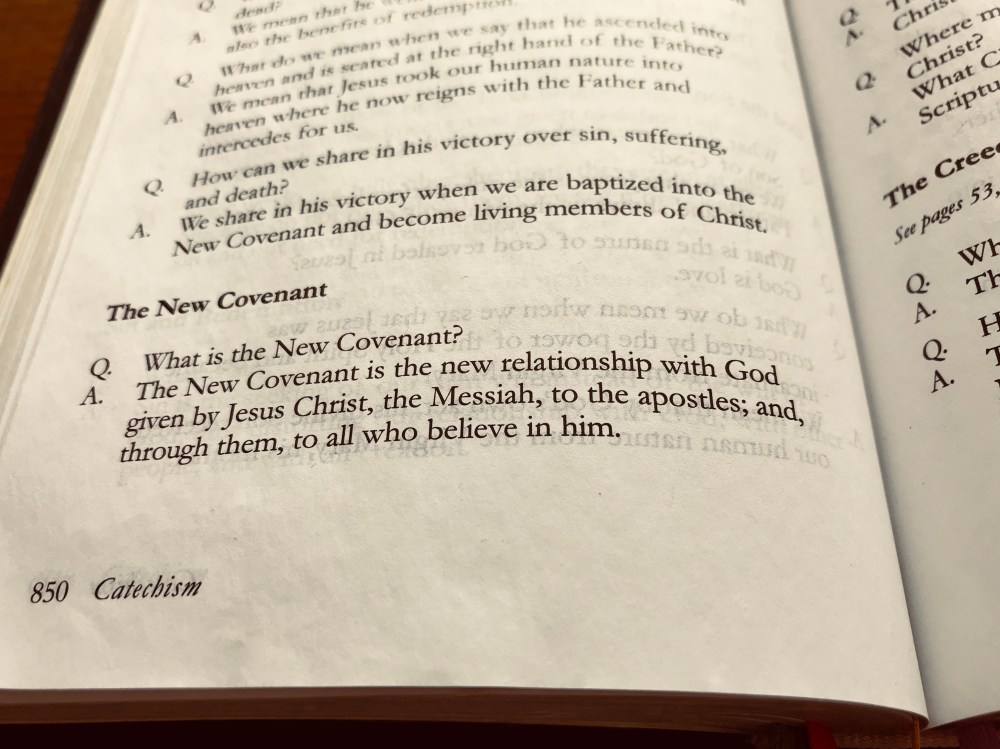
And today, we arrive at the conclusion of this series of readings as we hear about what the prophet Jeremiah calls “the new covenant.” For us Christians, the New Covenant is articulated clearly in our Prayer Book’s Catechism (on page 850), which says, “the New Covenant is the new relationship with God given by Jesus Christ, the Messiah, to the apostles; and through them, to all who believe in him.” The New Covenant is the covenant through which we as Christians can fully enjoy and participate in all of the previous covenants, including the Abrahamic covenant. It is the covenant through which we can enter into a personal and communal relationship with God. It is the covenant in which God gives to us what he has been wanting to give us all along: Himself.
Through Noah, God promised we will survive. Through Abraham and Moses, God promised we will thrive. Through Christ, God gave us himself, in whom we ultimately abide.

When we celebrate the Eucharist we remember Jesus saying to his disciples, “This is my Blood of the New Covenant.” This is God’s way of expressing his self-giving love to us; God’s way of saying to each of us, “I give myself to you.” The ancient concepts of blood and sacrifice, which are associated with all of the covenants, may initially sound outdated and primitive and even disturbing to us today; but these concepts are all communicating the same thing: God’s self-giving love, which we see expressed most clearly and fully in the Cross of Jesus Christ.
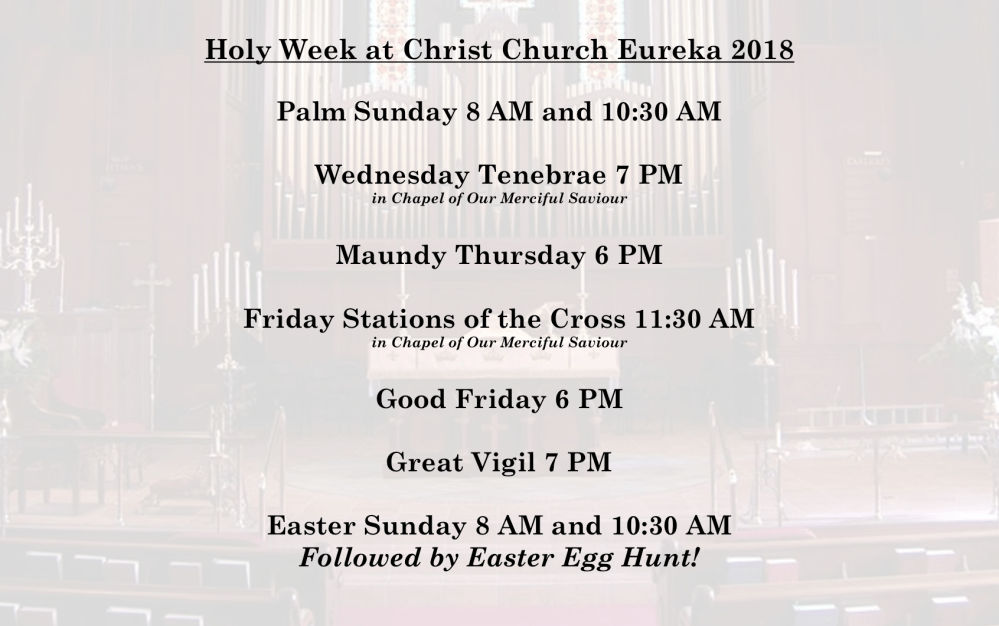
As a faith community, we have responded to the invitations and claimed the blessings of the Noahic, Abrahamic and Mosaic covenants. Today the New Covenant calls for another response from us. The New Covenant calls us to gather around the Cross and to contemplate the infinite depths of its mysteries. Let us heed this call by participating together in the most transformative and powerful liturgies of the church year: the liturgies of Holy Week. According to biblical and liturgical scholar Derek Olsen, “It can be said without exaggeration that [Holy Week] is the season where faithful attendance at the public liturgies of the Church matters the most and renders the most” (113). By participating in Palm Sunday, Maundy Thursday, Good Friday and the Great Vigil, we get to feast royally on God’s self-giving love so that we can embody that love in the world. We let ourselves deeply nourished by God so that we can nourish others.
If we are not rooted deeply in God’s self-giving love, we will get depleted and burn out. I know I will. If we are not rooted in the promise of the New Covenant, then we are ultimately irrelevant as a community. Our outreach services, our conversations about gun violence, the beauty of our sanctuary really don’t mean much if we do not first realize that everything we do flows out of our common experience of receiving God’s self-giving love together here, receiving the Body and Blood of the New Covenant.
In the Gospel, we read about some Greeks approaching Jesus’s disciples and saying, “We wish to see Jesus.” Jesus responds to their request by talking about his sacrificial death on the Cross. If we wish to see Jesus and make Jesus known here in Eureka and Humboldt county, then let us gather around the mystery of the Cross this next week. Let us participate as fully as possible in the liturgies of Holy Week; and let us receive the promised gift of the New Covenant, which is God himself. May it be so. Amen.

 DANIEL DeFOREST LONDON