
Readings for Ash Wednesday
This sermon was preached at Christ Episcopal Church in Eureka CA on February 14, 2018.
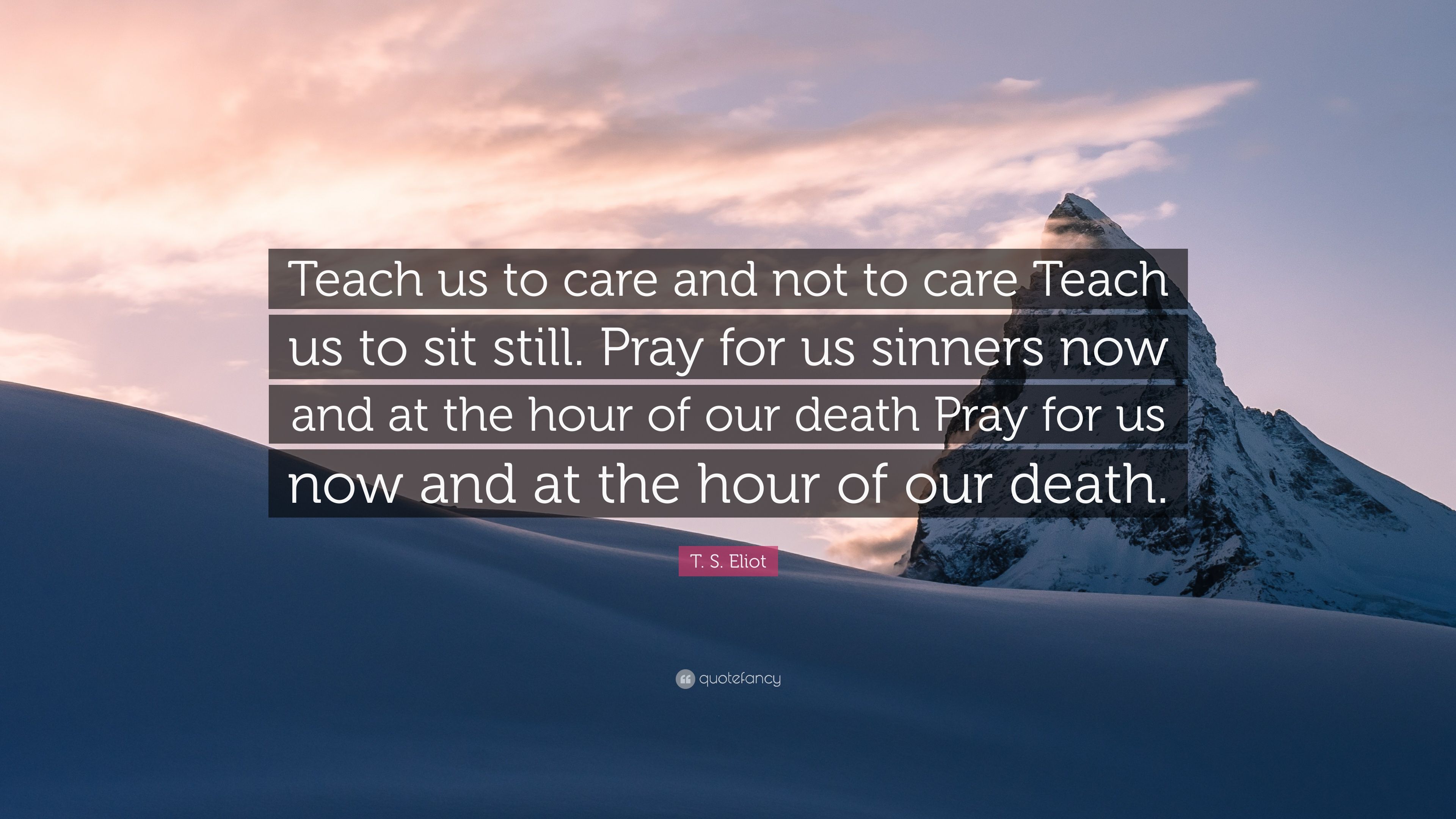
Upon his conversion to Anglicanism, T. S. Eliot wrote a long poem about trees and gardens and growth titled “Ash Wednesday” in which he repeats this short yet slightly enigmatic prayer: “Teach us to care and not to care / Teach us to sit still.” In the Gospel reading for Ash Wednesday, Jesus invites us to care; to care about the treasures we store up in heaven through our secret acts of devotion and he invites us not to care, not to care about how holy and pious we might appear to people around us. And he invites us to sit still. He says, “Whenever you pray, go into your room and shut the door and pray to your Father who is in secret.” He says, “Go and find your place of prayerful silence and solitude, your personal hermitage, your ereymon topon.” Find that place and spend time there because it is by spending time there in stillness and prayer that we store up for ourselves treasures in heaven.
My invitation to us this Lent is for each of us to spend twenty minutes a day in prayerful silence and solitude. If you’re already doing that, try ten more minutes. This is a challenging invitation. It’s often not easy to sit alone in silence. It can feel counter-intuitive and unproductive and sometimes frightening; and often we are nagged and distracted by the many thoughts of what the Buddhists call “our monkey minds.” And that’s normal and that’s ok. All those thoughts can be offered up as prayers themselves and they can be seen as opportunities to let go and let God hold all of our fears and concerns.
Personally, In my times of prayerful silence, I often feel like I’m being unproductive, like there is something else I should be doing. However, it is those times of silence and solitude that are absolutely necessary for spiritual growth. In fact, scientists actually recently discovered that new brain cells (cells in the hippocampus, which is associated with memory, emotion and learning) can actually develop and regenerate as a result of intentional silence.[1]
It is in prayerful silence that we absorb God’s healing love like a plant absorbs nutrients from the soil.
In a few moments, we will mark our foreheads with ashes. These ashes are a sign and symbol of our penance and our mortality and our human finitude. And yet ashes are also some of the most nutrient-rich fertilizers on the planet. Ashes help trees and plants and gardens grow, like the trees and gardens T. S. Eliot described in his poem. Author Alexander Shaia says, “To be touched with ash is a prayer for the grace and nutrients to grow ever more deeply into the image of the One in which we are already made.”
As we repent and remember that we are dust, and as we receive the imposition of ashes, let us also remember this Lent to absorb the grace and spiritual nutrients of silence and solitude.
Teach us to care about the spiritually productive value of silence.
Teach us not to care about our apparent piety.
Teach us to sit still.
Amen.
[1] http://www.lifehack.org/377243/science-says-silence-much-more-important-our-brains-than-thought, accessed February 14, 2018.

 DANIEL DeFOREST LONDON