
ὅταν ἐν τῷ κόσμῳ ὦ, φῶς εἰμι τοῦ κόσμου.
Hotan en to kosmo o, phos eimi tou kosmou
As long as I am in the world, I am the light of the world
A more literal translation of this short verse would be more Yoda-like: “As long as in the world I am, light I am of the world.” Although I use the phrase “I am” twice in the translation, Jesus does not use the formulaic ego eimi at all in this verse. Instead he uses the present subjunctive for “I am”: ὦ (o); and then the present indicative εἰμι (eimi), without the first person pronoun ἐγώ (ego). [I just saw some graffiti today that read, “Your ego is not your amigo”]. So here, Jesus is being ego-less (:
Jesus includes the “ego” when he first identifies as the Light of the World in chapter 8 verse 12, a statement which, as I suggested in a John-in-July post, was intended to reference Isaiah 9:1-2 in response to the Pharisees’ insistence that “no prophet is to arise from Galilee” (7:52). According to Isaiah 9, “God will make glorious the way of the sea, the land beyond the Jordan, Galilee of the nations. The people who walked in darkness have seen a great light, those who lived in a land of deep darkness—on them light has shined.” Jesus says, “You know that light Isaiah talked about in the context of Galilee? I am that light. I am the Light of the World (Ἐγώ εἰμι τὸ φῶς τοῦ κόσμου).
So why does Jesus identify again as the Light of the World in this context, after likely quoting a Jewish proverb? Moreover, how does this serve as an answer or response to the question of suffering?
Johannine scholar Herman C. Waetjen writes, “According to Philo of Alexandria, the ‘light of the world’ is the light of the first day of creation, and it is an image of the divine Logos who makes itself intelligible by means of interpretation.’”[1] One does not have to agree with Waetjen’s argument that the Fourth Gospel was written in Alexandria to accept that Philo’s ideas were clearly in the air that the Fourth Evangelist breathed. On the first day of creation, the Word (Logos) of God proceeded from God and produced light: “God said, ‘Let there be light’; and there was light” (1:3). For Philo, the light and the Logos become one and the same. So by calling himself the Light of the World, Jesus is saying that he is the light of the first day of creation, a manifestation of the Logos of God.
In order to unpack the significance of the Johannine Light and Logos in the context of the question of suffering, we will need the light and illumination that is provided by a series of insights referred to collectively as Mimetic Theory, as articulated initially by René Girard.
Mimetic Theory:
- Mimetic Desire
In his first book Mensonge Romantique et Vérité Romanesque, René Girard argues that human desire is the result of the imitation or mimesis of another person’s desire.[2] Although the English translation of this book includes a different title (Deceit, Desire and the Novel: Self and Other in Literary Structure), the translation of the French title offers a more precise description of his argument: “The Romantic Lie and the Novelistic Truth.” By analyzing the literary works of Cervantes, Stendhal, Proust, Flaubert, and Dostoyevksy, René Girard attempts to uncover the idea that human desire as unmediated, spontaneous and “the creation ex nihilo of a quasi divine ego” is, in fact, the “romantic lie” (mensonge romantique)[3] while showing that the triangular and mimetic nature of desire is the “novelistic truth” (vérité romanesque), wherein all desires are mediated through a model. Girard rejects a linear understanding of desire in which a subject merely desires an object as the diagram indicates below.

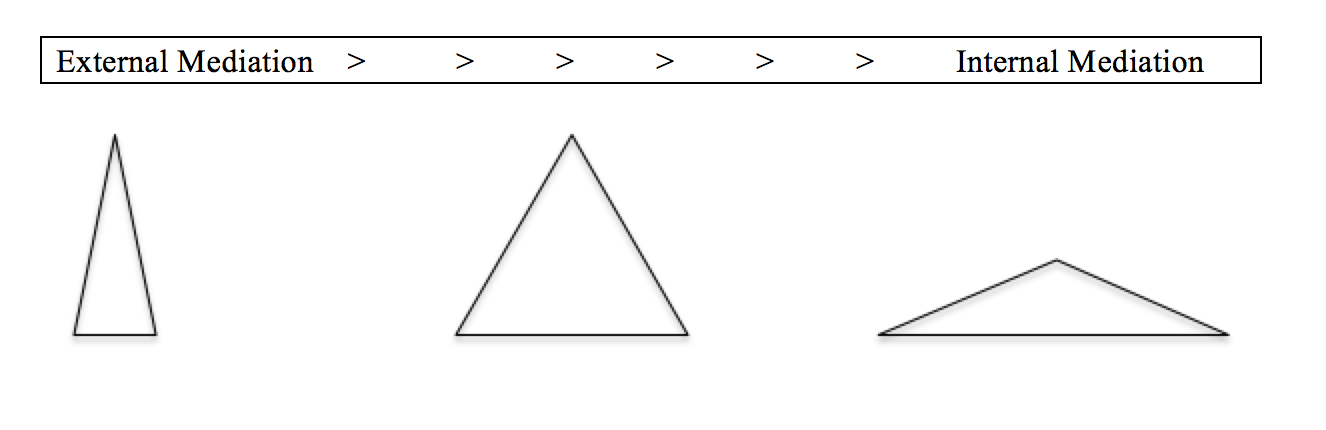
Instead, Girard offers a triangular understanding of desire in which the subject desires an object through the mediation of a model as the triangular diagram demonstrates below, with the vertices of subject, model and object.

Girard sees this triangle of desire as highly susceptible to the growth of resentment and violent tension between the subject and model. Girard explains that the potential for resentment and rivalry grows when the subject and model move closer to one another in geographical or temporal proximity. In other words, as the triangle collapses down and flattens wide, the close proximity of the subject and model triggers resentment between the two and they fall into what Girard calls a relationship of médiation interne (“internal mediation”). Conversely, as the triangle shoots up and elongates, the potential for resentment decreases and the subject and object remain relatively free from mimetic violence in a relationship of médiation externe (“external mediation”). For example, the potential for violent tension between Don Quixote and his model Amadis of Gaul remains minimal due to the temporal and spatial distance between the two. Don Quixote will never actually meet his ideal knight-errant primarily because Amadis of Gaul remains only a character in the books that Don Quixote reads. However, in Dostoyevksy’s Notes from the Underground, the protagonist finds himself literally bumping up against his models and thus exacerbating the tension and potential for resentment and violence between the two, leading to médiation interne (“internal mediation”). Girard essentially offers a scale of mediated desire with external mediation (exemplified in Don Quixote) at one extreme and with internal mediation (exemplified in the Underground Man) at the other extreme. Between these two poles of mediation, Girard describes the characters and relationships of Stendhal, Flaubert, and Proust, locating “Stendhalian vanity,”[4] “Proustian snobbism”[5] and “Flaubertian bovarysm” along the scale.[6]
The relatively innocuous nature of external mediation in Cervantes’ Don Quixote becomes most apparent when contrasted with the internal mediation embodied in many of Dostoyevsky’s characters, whose rivalry and resentment boil and swell into what Girard calls the “Dostoyevskian Apocalypse.”[7] The resentment aroused in internal mediation infects the subject like an “ontological sickness” and “grows more and more as the mediator approaches the desiring subject.”[8] As the triangle of desire collapses down and flattens wide, the subject’s relationship to the mediator becomes more and more marked by obsession, rivalry and resentment, to the extent that the desired object becomes almost irrelevant as the subject and mediator fall prey to violence.[9] Girard writes, “By making one man’s desire into a replica of another man’s desire, it inevitably leads to rivalry; and rivalry in turn transforms desire into violence.”[10] Since all of humanity remains vulnerable to this mimetic violence and resentment, the consequence appears to be a bellum omnium contra omnes, thus making all human lives indeed “nasty, brutish, and short.”[11] This seemingly inevitable violence and all-against-all war, however, are halted by a social “brake” called that Girard calls the scapegoat mechanism.
- Scapegoat Mechanism
In his magisterial work Violence and the Sacred, Girard develops his second insight, which explains how the grim prospect of “all-against-all” war becomes superseded by the “all-against-one” mechanism of scapegoating. The violent tension between the subjects and models caught in médiation interne (“internal mediation”) does not lead to the destruction of all humankind but rather to the violent expulsion of one victim who bears the brunt and thereby placates the violent tension. According to Girard, the scapegoat mechanism has allowed humanity to survive without wiping itself out completely. The human compulsion to scapegoat, blame and expel victims therefore lives within the soil that feeds humanity’s root impulse to survive.
In order to persist in violent scapegoating, humanity has found creative ways to repress culpability and the disturbing reality of participation in collective murder. Humans, according to Girard, create stories that illustrate the victim’s responsibility for the violent tension within médiation interne and thereby justify the communal lynching of the victim. These stories then function as the founding myth of a culture, informing customs, rituals, and taboos. The founding murder is reenacted in the ritual of sacrifice on a regular basis in order to consistently placate the potential violence within a community.
Humanity furthermore ‘wipes its hands clean’ of the guilt of murder by projecting the compulsion to scapegoat onto God. Humans interpret the communal peace and catharsis of unleashing violence upon a victim as a sign of divine approval and so learn to experience God as a bloodthirsty deity, thus successfully repressing and denying the blood thirst that is humanity’s own. The myths and rituals that order and sustain culture are essentially lies that humans tell themselves in order to survive. However, if Girard’s audacious second insight holds truth, then how have some (like Girard himself) come to realize the unsettling reality behind these lies, which have so long deceived humanity?
- Revelation of Divine Non-Violence
The third insight of mimetic theory asserts that the murderous truths, which have been hidden beneath the founding myths and rituals, or in biblical language, “hidden since the foundation of the world” (Matthew 13:35), have come to light through the revelatory Jewish and Christian Scriptures. Although the scriptures at times are prone to project violent blood thirst onto God, the main thrust of the biblical literature, according to Girard, is to reveal God as a God of victims. This revelation is made abundantly clear in the Gospels, in which God’s representative on earth, Jesus of Nazareth, does not assert himself as one who demands bloodshed but rather offers himself as the victim of human scapegoating violence.[12] Jesus launches a mission that discloses the murderous reality hidden by founding myths, thus deflating their power and revealing God as wholly non-violent, thus inviting humans to accept responsibility for participation in collective murder and to essentially say, “We have met the bloodthirsty deity and he is us.”[13] Furthermore, Jesus reveals God as an advocate for victims of religious violence. The name that the Johannine Jesus gives to the Holy Spirit who will continue to lead his followers into truth (16:13) is the Paraclete, the Advocate, who defends victims of religious violence, which he describes when he says, “an hour is coming when those who kill you will think that by doing so they are offering worship to God” (16:2).
- Reading Scripture in Light of Mimetic Theory
The insights of mimetic theory provide an approach to reading and interpreting Scripture that allows the reader to “be on the lookout for traces of the [scapegoating mechanism] and its opposite in the text.”[14] Instead of perpetuating the belief in a bloodthirsty deity, which has been used to justify religious violence, mimetic theory provides a critical and theoretical framework for re-interpreting passages of Scripture that, on the surface, appear to promote a violent god. By using the Gospel revelation that God is a God of victims as a hermeneutical lens, the reader is invited to see within the biblical text the human roots of religious violence and the divine compassion for its victims. Furthermore, the reader is invited to deconstruct and demythologize some of the mythic tendencies in Scripture, which can succumb to the lie that God demands violent scapegoating and sacrifice. “Girard,” according to Wolfgang Palaver, “understands the mimetic theory as a form of deconstruction that…serves the interpretation of texts.” Palaver also writes, “According to Girard, biblical revelation is a source for the demythologization or deconstruction of myth and all institutions and cultural forms that emanate from it.”[15] Authors such as James Williams, Robert Hamerton-Kelly, Gil Bailie, James Alison, S. Mark Heim and more recently Sandra Schneiders have employed the insights of mimetic theory in their readings of Scripture to demonstrate how the biblical text reveals divine non-violence and humanity’s complicity in violence.[16]
The plan is to utilize the insights of mimetic theory to demonstrate how the reader can bring the question of suffering to the text in order to be transformed by an encounter with Jesus, specifically as he is revealed in the Fourth Gospel, a gospel written for the expressed purpose of arousing new life in the reader.
The Light in Light of Mimetic Theory
If the Light of the World is the light at the beginning of creation and the Logos itself, we need to investigate the meaning of the Logos in light of Mimetic Theory. In Things Hidden Since the Foundation of the World, René Girard writes about the Johannine Logos and contrasts it with the Logos of Heraclitus and Heidegger. According to Girard, “Heidegger recognizes that the Greek Logos is inseparably linked with violence.”[17]
For Girard and most Girardians (including Gil Bailie), there are two kinds of Logos or two Logoi if you will. There is the Johannine Logos of creation that is wholly non-violent and there is the Heraclitean and Heideggerian Logos, which is the logic of violence itself. Heraclitus writes,
“War [polemos] is the father and king of all things; he has shown some to be gods and some mortals, he has made some slaves and others free…Everything originates in strife…Strife is justice; and all things both come to pass and perish through strife.”[18]
For Heraclitus, this war [polemos] or violence is the ordering principle and logic of all things. Heraclitus seemed to understand the murderous truths, which have been hidden beneath the founding myths and rituals, or in biblical language, “hidden since the foundation of the world” (Matthew 13:35). However, instead of rejecting this Logos, Heraclitus hails it as the “Father and king of all things.”
According to the Fourth Gospel, there is another Logos that preceded the Logos of Violence. The Logos that came into being with the Light of creation is the Logos of love and the way that the Logos of love reveals itself to a world dominated by the Logos of violence is by embodying itself in the role of an expelled victim and outcast. As I wrote last July, in John 1, God does not offer life and then withhold wisdom or “knowledge of good and evil [as God appears to do in Genesis];” instead, God seeks to give life and enlightenment to everyone. And in this re-telling of the Creation story, the humans are not the ones cast out by God; instead, God is the one cast out by humans: “He came to his own and his own rejected him.” Right away, God takes on the role of the victim, the one who is rejected and cast out. God is the outcast. And those who receive the outcast are given power to become children of God (1:12).
The Logos and the Light of the World reveal God as Outcast in a world that is driven by the Logos of violence. So as long as Jesus is in the world, he is the light of the world, which reveals God as Outcast and illuminates the Logos of violence.
This revelation and illumination will become more clear as the pericope progresses in the trial scene, as the one whom Jesus heals (Celidonius) is expelled from the synagogue. We will come to see how connection to Christ becomes linked with expulsion from the world.
[1] “Now that invisible light falling in the province of the mind has come into being as an image of the divine Word (qeiou logou), the one interpreting its origin” [Philo, de Opificio Mundi, 31] Herman C. Waetjen, The Gospel of the Beloved Disciple: A Work in Two Editions (New York: T & T Clark, 2005), 251.
[2] René Girard, Deceit, Desire & the Novel: Self and Other in Literature Structure. Translated by Yvonne Freccero (Baltimore: Johns Hopkins University Press, 1965). Hereafter abbreviated as DDN.
[3] René Girard, DDN, 15-16. Towards the end of the book, Girard writes, “The early romantic wanted to prove his spontaneity—his divinity—by desiring more intensely than Others…Nobody today believes in noble spontaneous desires. Even the most naïve recognize the mediator’s shadow behind the frantic passion of early romanticism.” DDN, 270.
[4] Girard, Deceit, Desire and the Novel, 22-23
[5] Girard, Deceit, Desire and the Novel, 23, 41
[6] Girard, Deceit, Desire and the Novel, 24.
[7] Girard, DDN, 256-289.
[8] Girard, DDN, 279.
[9] Girard, DDN, 279 – 280. The ultimate result of this “ontological sickness” is death. Girard writes, “The contradictions caused by internal mediation end by destroying the individual. Masochism is followed by…self-destruction, physical self-destruction in all Dostoyevsky’s characters who are dedicated to evil: Kirilov’s suicide, the suicides of Svidrigailov, Stavrogin, and of Smerdiakov; and finally spiritual self-destruction…Inevitably, the fatal outcome of ontological sickness is, directly or indirectly, a form of suicide.”In the case of Kirilov from the novel The Possessed, the mediator is Christ, however “not in the Christian, but in the Promethean, the novelistic, sense of the word.” As a novelistic mediator, Christ functions as a rival to Kirilov, who covets Christ’s divinity. Girard describes this as a “diabolic rivalry” that reveals the “satanic side” of arrogant, internal mediation. Although the ontological sickness of Kirilov’s internal mediation with Christ leads to Kirilov’s suicide, … This dissertation examines how the Johannine Jesus responds to similar forms of diabolic rivalry and resentment in the Fourth Gospel with invitations to love and abundance. Furthermore, I argue the response of the Johannine Jesus to the rivalry and resentment of other literary characters in the Fourth Gospel invites the reader to experience for him or herself the divine response to human resentment in general. Girard, DDN, 227.
[10] Girard, Violence and the Sacred, 169.
[11] “War of all against all” from Thomas Hobbes, Leviathan, ed. Hermann Klenner (Hamburg: Meiner Verlag, 2005), 673. “And the life of man, solitary, poore, nasty, brutish and short” I.13 in Thomas Hobbes, Leviathan ed. C.B. Macpherson (Baltimore: Penguin Books, 1968), 186.
[12] René Girard, Job: The Victim of His People, Translated by Yvonne Freccero (Stanford: Stanford University Press, 1987), 154.
[13] Inspired by Walt Kelly, creator of the Pogo Poster Earth Day 1970: “We Have Met the Enemy and He is Us.”
[14] Robert G. Hamerton-Kelly, The Gospel and the Sacred: Poetics of Violence in Mark (Minneapolis MN: Fortress Press, 1993),13.
[15] Wolfgang Palaver, René Girard’s Mimetic Theory, translated by Gabriel Borrud (East Lansing: Michigan State University Press, 2013), 270. See Girard, Violence and the Sacred, 66; Things Hidden, 191, 247, 429; The Girard Reader, 137-138; “Mythology,” 116; “Victims,” 134; Goodhart, Sacrificing Commentary, 183 as noted in Palaver, Mimetic Theory, 360.
[16] See James G. Williams, Bible, Violence, and the Sacred: Liberation from the Myth of Sanctioned Violence (Harper Collins, 1991); Gil Bailie, Violence Unveiled: Humanity at the Crossroads (New York: Crossroad Publishing Co., 1995); Robert G. Hamerton-Kelly, The Gospel and the Sacred (Minneapolis MN: Fortress Press, 1993); James Alison, Faith Beyond Resentment: Fragments Catholic and Gay (New York: Crossroad Publishing Co., 2001); S. Mark Heim, Saved from Sacrifice: A Theology of the Cross (Grand Rapids MI: William B. Eerdmans, 2006); Sandra M. Schneiders, “‘Whose Sins You Shall Forgive…’: The Holy Spirit and the Forgiveness of Sin(s) in the Fourth Gospel” (119-148) and “The Lamb of God and the Forgiveness of Sin(s) in the Fourth Gospel” (149 – 182) in Jesus Risen in Our Midst: Essays on the Resurrection of Jesus in the Fourth Gospel (Collegeville MN: Liturgical Press, 2013).
[17] René Girard, Things Hidden Since the Foundation of the World translated by Stephen Bann and Michael Metteer (Stanford: Stanford University Press, 1978), 265. Martin Heidegger, Introduction to Metaphysics, 123-135; ‘Logos,’ Essais et conferences, pp. 249- 278.
[18] Nahm, Selections from Early Greek Philosophy, 62 as cited by Gil Bailie, Violence Unveiled: Humanity at the Crossroads (New York: Crossroads, 1995), 241.

 DANIEL DeFOREST LONDON