
“Instructions for living a life. Pay attention. Be astonished. Tell about it.” – Mary Oliver
Καὶ παράγων εἶδεν ἄνθρωπον τυφλὸν ἐκ γενετῆς
(Kai paragon eiden anthropon tuphlon ek genetes)
“And walking along he saw a man blind from birth…” (9:1)
This verse begins with the most common New Testament conjunction “kai,” used more than 9,000 times in the Christian Scriptures. It can mean “moreover,” “even,” “indeed,” “also” but most often means, as it does in this case, simply “and.”
Although this verse begins a new Johannine pericope, the kai conjunction connects this passage with the previous pericope (in John 8), as it revisits similar themes, especially the theme of Jesus as light. The “devil” and “demon” rhetoric of chapter 8 recedes almost completely in this chapter even though ‘satanic’ accusation still runs rampant. And Jesus will be accused again of having a demon in verse 10:20. For now, other images will be used to describe the roles of accuser and accused: blindness / vision, wolf / sheep, false shepherds / Good Shepherd.
The word παράγων is from the verb παράγw, which, according to some early manuscripts, shows up only here in John and can mean either “go on” or “pass by.” However, some later manuscripts of John include an extra phrase at the end of verse 8:59, which includes the word παράγeν in the phrase “and passing through the midst of them he passed by” (kai dielthon dia mesou auton eporeueto kai paragen outos – a phrase that resembles Luke 4:30). So, according to later manuscripts, soon after stealthily escaping a stoning to death by his Jewish interlocutors, Jesus passes by a man born blind. Although the later manuscripts connect chapter 8 with chapter 9 more clearly with the use of παράγw the pericopes still remain distinct based on content and setting and characters.
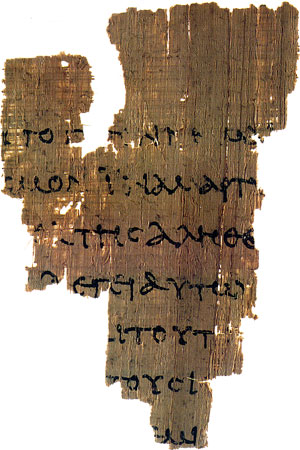
Speaking of manuscripts, however, it is worth stating now that I will primarily be using the manuscript referred to as P66 (Papyrus Bodmer II), which is dated to around 200 C.E. and contains most of John’s Gospel: 1:1—6:11; 6:35—14:26, 29-30; 15:2-26; 16:2-4, 6-7, 16:10—20:20, 22-23, 20:25—21:9. Fun fact: the oldest surviving fragment of the New Testament is a fragment of John called P52 (John Rylands Papyrus 457) dated to the second century and containing only a few verses of the Johannine Passion Narrative (“Pilate said to them, ‘Take him yourselves and judge him according to your law.’ The Jews replied, ‘We are not permitted to put anyone to death.’ This was to fulfill what Jesus had said when he indicated the kind of death he was to die.” John 18: 31-33. “Pilate asked him, ‘So you are a king?’ Jesus answered, ‘You say that I am a king. For this I was born, and for this I came into the world, to testify to the truth. Everyone who belongs to the truth listens to my voice.’ Pilate asked him, ‘What is truth?’ After he had said this, he went to the Jews again and told them, ‘I find no case against him.'” John 18: 37- 38)
As Jesus walks along, he sees (εἶδεν from the verb ὁράω – horao) an anthropon tuphlon ek genetes. According to the 18th century Russian Orthodox Saint Dmitry of Rostov, early Christian tradition knew the anthropon tuphlon (blind man) by name as Celidonius. His healing is remembered on the Sixth Sunday of Easter, which in the Eastern Church is known as the “Sunday of the Blind Man.” Tradition also credits Celidonius with founding the church in Nîmes, which is about 25 miles away from Avignon.
This September, I’m going to walk through the first 7 verses of John chapter 9 and see what there is to see, verse by verse, to become more acquainted with the chapter, in a way similar to my month-long stint with the whole book of John last July. I’m thinking about narrowing the focus of my dissertation on chapters 9 and 10 of John in order to attend more closely to Jesus’s response to the question of suffering as asked by his disciples in the next verse.
I like how the Christian tradition has given the anthropon tuphlon a name as well as a story beyond the Gospel text thus allowing me to spend my September with Celidonius. As I did in July, I will also be spending my September with someone who was born 25 miles away from Celidonius’s church in Nîmes on Christmas day in 1923: that is, the French literary theorist René Girard, whose mimetic theory will help me read and interpret and see the text in a hopefully transformative and healing way.
So we begin our walk through the chapter and, like Jesus, we will look and try to see what there is for us to see.
…
P. S. (4 months later – Jan 21, 2016)
Although there are thematic and potential literary connections between John 8 and 9 as mentioned above, it is important to note that John 9:1 introduces an entirely new narrative (something that we cannot say about John 10:1). Culpepper sees the single pericope of John 9 and 10 as “an interpretive interlude” which advances themes (light and judgment) but not necessarily plot.[1] Bultmann sees the verse introducing a new isolated narrative[2] while Brown suggests that there may have been a substantial time lapse between 8:59 and 9:1.[3] Holleran highlights the change of location between verse 8:59 and verse 9:1, a verse that also introduces a new dramatis personae: Jesus, the disciples, and our friend Celidonius.[4]
[1] Culpepper, Anatomy, 93 – 94.
[2] Bultmann, John, 330.
[3] Brown, John 1: 376.
[4] G. Mlakuzhyil, The Christocentric Literary Structure of the Fourth Gospel (Analecta Biblica, 117) Rome, 1987, pp. 93, 114, 205 as cited by J. Warren Holleran, “Seeing the Light: A Narrative Reading of John 9: I Background and Presuppositions” Ephemerides Theologicae Lovanienses (1993), 5-26 (12).

 DANIEL DeFOREST LONDON