

Readings for the Wedding of David William Harty and Martha Buckle Shear:
Tobit 8:5b-8
1 Corinthians 13:1-13
Matthew 5:1 – 10
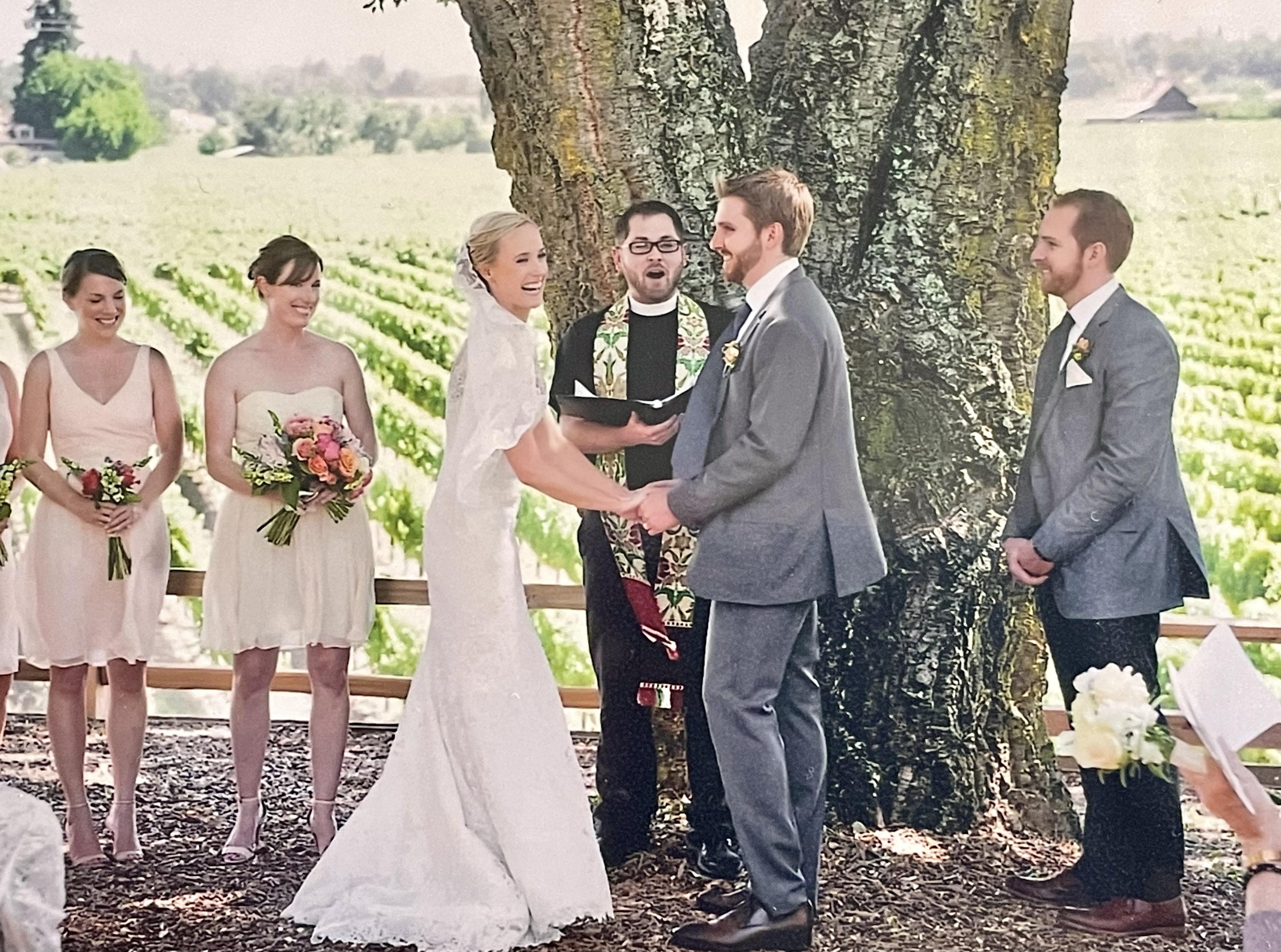
This sermon was preached at the Wedding of David Harty and Martha Shear on June 21, 2014 at Ru’s Farm at Healdsburg Country Gardens in Healdsburg CA.
Over the last few months, I have been meeting with David and Martha over pizza and wine in Berkeley, planning this ceremony and discussing its spiritual significance. It has been a joy for me to experience their profound love for each other, which seems to overflow and spill on those around them. And today we all get to bask in that love as we witness and bless them in the sacrament of marriage.
The love which Martha and David embody invites us all to see the sacred beauty and holiness in those we love and in every moment we share. In the Jewish tradition, the center of the wedding takes place when the man and woman say to each other “Harei at mekudeshet li” which means “You are holy to me.” Although David and Martha already see each other as holy, this ceremony ritualizes that seeing while inviting us all to enter into that same vision, to see our loved ones and the moments we share as holy.
The Gospel reading, which David and Martha chose for this occasion, includes the opening words of Jesus’ ‘Sermon on the Mount,’ which are known collectively as the Beatitudes. I like to think of the Beatitudes as “Attitudes that help us ‘Be’”, or more specifically, as attitudes that help us be present to the holiness and blessedness of each moment, especially those moments we share with those we love. The words of the Beatitudes offer an invitation to Martha and David (and to all of us) to be present to the blessedness of this union and to the holiness of love in all of our lives.
In the Beatitudes, Jesus is ultimately calling us to be vulnerable with one another and to see the beauty in each other’s humanity, including our imperfections. When Jesus talks about being “meek” and “poor in spirit” he is not talking about being treated like a doormat or lacking a backbone. He is talking about being vulnerable and human, trusting that we will be loved and held in our humanity and vulnerability. He is also talking about letting go of our self-importance, not getting caught up in our ego’s demands, and not taking ourselves so seriously, so that we can be more open and present to the life and love that is happening all around us.
In the Beatitudes, Jesus invites us to see beauty and holiness in those experiences that we might initially dismiss as negative or dismal. He invites us to see the beauty in tears, in spiritual hunger, and even in unjust persecution. These are all opportunities for deeper intimacy: to give and receive comfort, to fill and be filled and to grow in empathy for one another in the midst of life’s challenges. In a few minutes, you –David and Martha—will promise to have and to hold one another “for better for worse, for richer for poorer, in sickness and in health.” The Beatitudes invite you to see the beauty, the holiness and the potential for joy in times of sickness, poverty and pain. See these as opportunities to fall more deeply in love, to grow in affection for one another and to strengthen the bonds that hold you together. See these as opportunities to take care of one another, to heal and to hold each other and to grow in awe of each other’s beauty.

The Beatitudes also invite you to take the time to ‘be still’ in order to see the beauty all around you and to relish in each other’s love.[1] One of Martha and David’s favorite songs is called “Let’s Be Still.” The chorus of the song captures well the meaning of the Beatitudes: “The world’s just spinning a little too fast / So just for a moment, let’s be still.” Be still and soak in the love that is all around you and right in front of you, in this moment. And let this love water the roots of your life together.
Jesus’ Beatitudes were inspired by the poetry of the Psalms, a collection of prayers in the Hebrew Bible, which invite the reader to see the world “charged with the grandeur of God.” The image that roots all of the prayers in the book of Psalms is one described in the first Psalm, which is also a Beatitude: “Blessed are they who delight in the holiness of one another and the beauty of each moment[2] for they are like trees planted by streams of water, bearing fruit in due season, with leaves that do not wither; everything they do shall prosper” (Psalm 1:1-3). David asked Martha to marry him under what they call a “magic tree” and it is appropriate that we have gathered today under a magic tree, a powerful symbol of their union, fecundity and love. The love that David and Martha have cultivated radiates and expands out to all of us just as the branches and roots of this tree help shelter and uphold us. And as we are here, held by the roots and branches of this tree, let us remember that we have promised to support and water their love by urging them always into deeper commitment, to see the beauty in each other, and to practice attitudes that help them be present to the holiness of each moment they share.
So may the Beatitudes and the love of all of us water the roots of your marriage as you grow in seeing each other as holy; and produce sustenance for all those fortunate enough to find shelter under your “magic tree” which is your love. Amen.
[1] “Blessed are the pure in heart for they will see God”: In the Christian contemplative tradition, practitioners are taught to quiet the mind by focusing on a single sacred word. Sören Kierkegaard said, “Purity of heart is to will one thing” and this focusing on a single word allows the contemplative to access and understand God in a profound and more “purified” way. This purifying of the heart and mind allows the contemplative to be present to the divine in the here and now and in the love that surrounds her.
[2] Blessed are those who delight in the Law of the LORD, the Law which teaches us to see and respect the holiness in God and one another.


 DANIEL DeFOREST LONDON