
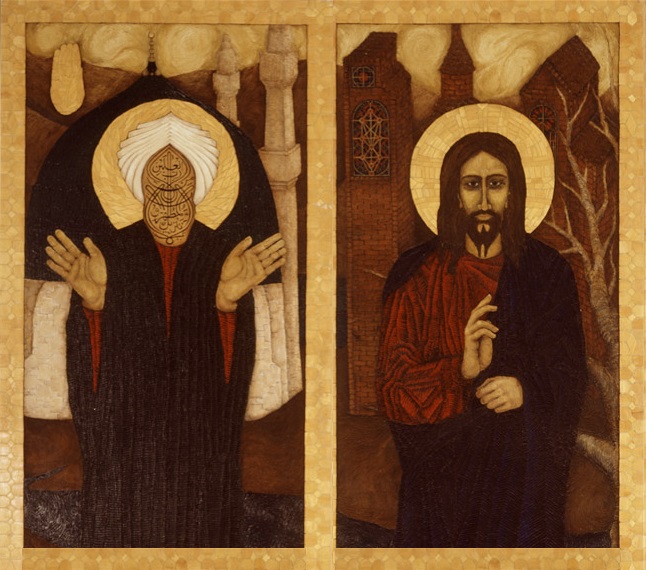
When Westerners hear of Sufis, they often think of the whirling dervishes (maybe from Madonna’s music video) or the elated poetry of the popular Persian Rumi, or severe acts of self-mortification. Although the twirling and self-mutilation may initially sound repulsive or ludicrous, the questions beg to be asked: Are the motivations behind such Sufi practices holy and laudable? Do Christians have something to learn from Sufis? In particular, can the Sufi view of Jesus as the “perfect Sufi” provide new insights into Christ and his teachings?
As the Westerner or, more specifically, the Christian, approaches Sufism with an open and teachable heart, the Sufi position on Jesus must eventually be addressed. Clearly, the Jesus of the Sufis differs considerably from the “Lord Jesus Christ” of orthodox Christianity. However, the Sufis hold the prophet Jesus in tremendously high esteem. Their appreciation and understanding of him (which is a Semitic understanding, and therefore more culturally tied to the historical Jesus) may answer some questions and reveal new truths about the Jesus to those who worship him as Lord.
Driven and inebriated by ecstatic encounter with the divine, the Sufis, technically referred to as the tasawwuf, embody the “inner power” and “heartbeat” of the Islamic faith since the faith itself is based on divine encounter as expressed through the Quran and the Prophet Muhammad.[1] Although primarily and reverentially charged by the Quran and traditional writings of Islam (Hadith), Sufism proves far less spiritually tame than mainstream Islam.
Instead of interpreting the Quran literally (a method known as tafsir), Sufis approach the text equipped with ta’wil, a more complex hermeneutic involving allegorical and symbolic interpretation. Though Sufis take zahir (the literal and obvious interpretation) seriously; they also look deeper for what they call batin, the mysterious and more advanced meaning of the text.[2] When the famous Sufi poet, Rumi, reads “Mention thy Lord oft, and give glory at evening and dawn”(3:38), he interprets this call to dhikr (“remembrance of the Lord”) as a call to twirl. Though the literal interpretation of the verse requires one to speak of Allah with great frequency, the Sufi interpretation requires one to obey the higher meaning of the text, which is to be consumed with God as often as possible, all throughout the day. So Rumi and the “whirling dervishes” perform their holy dance of spin in order to be caught up into the divine and euphoric presence.
Sufis practice other diverse rituals such as listening meditatively to music (sama), active chanting that often results in ecstatic spasms, piercing flesh, dancing in fire, swallowing fire and even biting heads off snakes. All of these are performed out of a desire to be consumed with the divine, to arrive “at a place where ego dissolves and a resonance with universal soul comes in.”[3]
Another Sufi approach to divine union is abstemious behavior as seen in the severe life of Abu Sa‘id ibn Abi al-Khayr. The extremes of his self-denial are disturbing and yet impressive. Abu Sa‘id began by committing to several strict rules:
“I fasted continually; I abstained from unlawful food; I practiced recollection of the name of God uninterruptedly; I kept awake at night; I never reclined on the ground; I never slept but in a sitting posture; I always sat facing the Ka‘ba; I never leaned against anything; I never looked at a handsome youth or a woman whom it would have been unlawful for me to see unveiled; I did not beg; I was content and resigned to God’s will.”[4]
Then, aware that “some angels worship God on their heads,” Abu Sa‘id decided to recite the Quran while hanging upside down. “Therefore,” he explains, “I placed my head on the ground and bade the blessed mother of Abu Tahir tie my toe with a cord and fasten the cord to a peg and then shut the door behind her. Being left alone, I said, ‘O Lord! I do not want myself; let me escape from myself!’ and I began a recitation of the entire Quran.”[5] The self-rejecting cry of Abu Sa‘id in the midst of his extreme self-mortification exposes the motivation behind such harsh Sufi austerity. When he approached a poignant verse, he said, “blood poured from my eyes and I was no longer conscious of myself.”[6]
After this experience, Abu Sa‘id realized that he had adhered to all these stern rules out of a desire to lose himself. Once he lost self-consciousness, he recognized the danger in such strict adherence. He wrote, “To refrain from religious acts is unbelief, but to perform such acts self-consciously is dualism, because if ‘you’ exists and ‘He’ exists, then two exist, and that is dualism. You must put your self away altogether.”[7] Ascetic practice works to rid one of the self, but if one practices asceticism self-consciously then the practice fails. For Abu Sa‘id, strict adherence to the rules paid off since he grew so highly “enamored of passing-away from [his] self” that eventually his “self vanished and [God’s] grace was all in all.”[8] So for some Sufis, strict asceticism is not performed for the sake of asceticism itself, but in order to rid one of the self and attain an intense union with the divine.
Dr. Javad Nurbakhsh, the present Master of the Nimatullahi Order of Sufis, says, “Citizens of every nation and believers of every religion follow some path or other with the aim of getting somewhere, gaining something, or becoming someone. The Sufi path, however, leads to non-being, loss of self, and passing away in the Beloved.”[9] Although not completely unique among religions, the Sufi goal of “non-being” certainly does appear foreign to a Christian reader.
The concept of “non-being” and “loss of self,” known as fana (literally “cessation of being”), developed most rapidly with the teachings of the famous Sufi Al-Junayd, who said, “Sufism means that God causes you to die to yourself and gives you life in Him.”[10] Fana goes hand-in-hand with an all-consuming life in God, known as baqa.[11]
Kabir Edmund Helminski, a translator and interpreter of Sufi literature, writes,
“In the Sufi tradition it is written that the absolute Spirit said, ‘And I breathed My Spirit into humanity.’ We are each enlivened by this inbreath. The essential Self, the soul, can be understood as this individualization of Spirit. The soul, however, is such a fine and subtle energy that it can be obscured by coarser energies of our existence, the energies of thought, desire, instinct, and sensation. These are the veils over the essential Self, the substances of intoxication that numb us to our essential Self”[12]
Although the Christian does not speak of each soul as an “individualization” of the divine spirit, the concept of an “essential Self” is not completely alien to Christianity. The Trappist philosopher-monk Thomas Merton, states a spiritual truth that, in some ways, resembles that of Helminski.
“At the center of our being is a point of nothingness which is untouched by sin and by illusion, a point of pure truth, a point or spark which belongs entirely to God…It is like a pure diamond, blazing with the invisible light of heaven. It is in everybody, and if we could see it we would see these billions of points of life coming together in the face and blaze of a sun that would make all the darkness and cruelty of life vanish completely”[13]
Christians also claim that “the LORD God breathed into [man’s] nostrils the breath of life”(Genesis 2:7) and that “God created man in his own image”(Genesis 1:27). Although the details of the Sufi’s doctrine differ considerably from Christianity, it is clear that Sufism and Christianity both share the concept of an entity within each individual that remains highly connected to God.
Aware of this commonality, the Catholic Thomas Merton studied the Sufi tradition and came to the conclusion that “they are after what we’re after: the dissolution of one’s present state to be reintegrated on a new level. Dissolution, rebirth…Death, resurrection…This is fundamental to Christianity…To reach a state in which we are not guided by our own will.”[14] “Of course,” Merton admits,
“They emphasize this much more than we do, but nevertheless, it is important for us too because we come here [to the monastery] to, in a certain sense, lose ourselves and to find ourselves by losing ourselves…It’s not self-extinction in order to become lost. This is a highly dialectical business, and it is losing oneself in order to find oneself. According to the Gospel concept, ‘He that would lose his life for My sake shall find it.’ It’s this ultimate losing and ultimate finding. This is the point, this is what we are here for and this is what we are looking for, and this is what life is really about. We are seeking union with God.”[15]
Connections and distinctions between the inner core of Sufism and Christianity can be seen most clearly in the Sufi’s view of Christianity’s embodiment: Jesus. We can get insight into that view by first considering “the greatest Muslim after Muhammad,”[16] Al-Ghazali. One of Al-Ghazali’s major contributions to the Sufi and Muslim world is his account of Jesus. Before looking at this, it is worth paying attention to his initial conversion to Sufism, which sounds almost like a Christian conversion. He writes,
“I considered the circumstances of my life, and realized that I was caught in a veritable thicket of attachments. I also considered my activities…and realized that in them I was dealing with sciences that were unimportant and contributed nothing to the attainment of eternal life. After that I examined my motive in my work of teaching, and realized that it was not a pure desire for the things of God, but that the impulse moving me was the desire for an influential position and public recognition.”[17]
In his own words, Al-Ghazali left his academic position and pursued the life of the Sufi in order to begin the work of “purifying my soul, improving my character and cleansing my heart for the constant recollection of God Most High.”[18] After discovering purpose and meaning in his new-found Sufi life, Al-Ghazali claimed that “their life is the best life, their method the soundest method, their character the purest character.”[19]
While studying among the Sufis, Al-Ghazali began writing several accounts of the life of Jesus, whom he described as an extraordinary ascetic. “It is related,” Al-Ghazali writes in one account, “that Jesus once laid his head to rest upon a stone. Satan passed by and said, ‘So, then, Jesus, I see you have found something to desire in this world after all!’ Jesus picked the stone from under his head and flinging it at him said: ‘Take this, and the world with it!’”[20]
Al-Ghazali explicates his own account:
“In point of fact, he who owns even a stone to use as a pillow for sleeping already owns of the world something which Satan can use to advantage against him. Thus, a person who spends the night in prayer and finds a stone nearby on which he can lay his head may be constantly tempted to sleep and to lay his head upon it. Were it not for the stone, the matter would not have occurred to him. And all this has to do with a stone! Can you imagine the case of someone who owns sumptuous pillows and beds and beautiful gardens? When would such a person ever feel the urge to worship God?”[21]
He uses this story of Jesus to explain that the smallest lack of self-denial can create tremendous space for Satan to lead one astray, away from the heart of God.
Other Sufi accounts of Jesus also present him in a similar fashion, as a model for Sufi austerity. Yet although he promotes the Sufi way of life, the Jesus of the Sufis proves not wholly distinct from the Gospel Jesus.
Tarif Khalidi, author of The Muslim Jesus, writes,
“The Jesus of Islamic Sufism became a figure not easily distinguished from the Jesus of the Gospels, and one reason must undoubtedly have been the growing familiarity with the Gospels among Muslim scholars. Yet the Jesus of the Gospel sermons fitted comfortably into the role of the Sufi preacher as is evident in the following: ‘Jesus preached to the Israelites. They wept and began to tear their clothes. Jesus said, “What sins have your clothes committed? Turn instead to your hearts and reprove them.”’”[22]
“Jesus,” Khalidi continues, “was enshrined in Sufi sensibility as the prophet of the heart par excellence.”[23] Dr. Javad Nurbakhsh adds, “In Sufi literature, Jesus is the paragon of a perfect human being and the example par excellence of a true master. In fact, throughout the centuries, in all their ‘Moslem-ness,’ the masters of Sufism, out of the purest sincerity and love, have had nothing but praise for Jesus, presenting him as a perfect Sufi.”[24] Yet to the Christian, the Gospel Jesus demands far more recognition than the title “prophet of the heart.” And unlike the Sufi’s Jesus, who “of course, is not the only central figure on the Sufi stage;”[25] the Christian upholds the Gospel Jesus as the most important human being to walk the earth, bar none.
Although the Jesus of the Sufis proves similar to the Christian Jesus in some beautiful ways, he remains, for the most part, strikingly different. Some teachings of the Sufi’s Jesus sounds repulsive to the Christian such as: “Seek the love of God by your hatred of sinners;” “Women are the ropes of Satan;” “He who has not been created is…happier than him who has;” “He who fears God does not laugh.” [26] Other statements from the Sufi’s Jesus cannot be easily reconciled with those made by the Gospel Jesus. While the Sufi’s Jesus proclaims, “How trivial the world is to God,”[27] the Gospel Jesus claims “God so loved the world” (John 3:16). The Sufi’s Jesus confesses, “The world existed and I was not in it, and it shall exist and I shall not be in it,”[28] while the Gospel Jesus asserts, “Before Abraham was born, I am” (John 8:58). The sinfulness of the Sufi’s Jesus made apparent in his confessions (that resemble Paul’s moral struggle in Romans 7) can find no parallel in the Gospels, but only opposition.
Furthermore, the most essential act to the Christian performed by the Gospel Jesus, the crucifixion (and resurrection), is altogether denied in Sufi Muslim accounts. In fact, one Muslim story of Jesus from the thirteenth century relates the dream of a man in which Jesus reveals to him the authenticity of his crucifixion. Yet “because the Glorious Qur’an specifically states that Jesus was not crucified or killed,”[29] the dreamer himself was put to death by crucifixion for blasphemy.
The clear conflicts between the Gospel Jesus and the Sufi Muslim’s Jesus point to the possibility that the Sufis and other Muslims created their own fictional accounts of Jesus so that he could more easily fit into the box the Quran built for him. Khalidi confesses, “The Islamic Jesus of the Muslim gospel may be a fabrication, nevertheless he remains a towering religious figure in his own right.”[30]
The Sufi’s Jesus, it must be said, also comes up with some wonderful expressions that Christians would have little trouble adding to their canon, such as: “Strive for the sake of God and not for the sake of your bellies;” “Charity means that you should do good to him who does you harm;” “If people appoint you as their heads, be like tails;” “One should not marvel at how they were damned…, but rather at how they were saved!” [31] A particularly poignant story of the Sufi’s Jesus involves the reek and repugnance of a rotting dog carcass, which onlookers look upon with disgust, abhorrence and nausea. Jesus, however, declares, “How beautiful are those teeth, displayed in the jaws!” teaching his followers to “overlook others’ faults.” [32]
In his own right, the Sufi Muslim’s Jesus does remain a “towering religious figure,” especially in his utter self-abnegation. “It is said that the sole worldly possession of Jesus was a cup from which he drank water. One day he chanced to see a man drinking water from his cupped hand. Thenceforth, he did without the cup, declaring, ‘Till now I was unaware that God had bestowed a cup upon me.”[33] “Jesus said, ‘The likeness of this world to the next is like a man who has two wives: if he pleases one, he arouses the other’s resentment.’”[34] Such a teaching sounds quite similar to James 4:4: “Don’t you know that friendship with the world is hatred towards God? Anyone who chooses to be a friend of the world becomes an enemy of God.” The theme of denying oneself of the world and its pleasures runs throughout the Sufi accounts of Jesus more than any other theme.
The austerity of the Sufis and the Sufi’s Jesus make more sense when seen in the context of fana. Yet what does this repugnance for the world have to do with self-annihilation? A poem by Rumi, titled “Jesus on the Lean Donkey” offers some lucid perspective:
Be grateful when what seems unkind
Comes from a wise person.
Once, a holy man,
Riding his donkey, saw a snake crawling into
a sleeping man’s mouth! He hurried, but he couldn’t
prevent it. He hit the man several blows with his club.
The man woke terrified and ran beneath an apple tree
with many rotten apples on the ground
“Eat!
You miserable wretch! Eat.”
“Why are you doing this to me?”
“Eat more, you fool.”
“I’ve never seen you before!
Who are you? Do you have some inner quarrel with my soul?”
The wise man kept forcing him to eat, and then he ran him.
For hours he whipped the poor man and made him run.
Finally, at nightfall, full of rotten apples,
Fatigued, bleeding, he fell
And vomited everything,
The good and the bad, the apples and the snake.
When he saw that ugly snake
Come out of himself, he fell on his knees
Before his assailant.
“Are you Gabriel? Are you God?
I bless the moment you first noticed me. I was dead
And didn’t know it. You’ve given me a new life.”
…
“If I had explained what I was doing,
you might have panicked and died of fear.
Muhammad said,
‘If I described the enemy that lives
inside men, even the most courageous would be paralyzed.’
…so I kept quiet
while I was beating you…
“I have no way to thank you for the quickness
of your wisdom and the strength
of your guidance.
God will thank you.”[35]
In Rumi’s poem, the sleeping man experiences a most rude awakening followed by excruciating exercises. Although the man in the poem does not bring the torment directly upon himself like the self-mortifying ascetic, both he and the ascetic undergo immense stress in order to oust a fatal being that lives within. But what does the snake in the poem represent to the ascetic Sufi?
Dr. Javad Nurbakhsh, author of Jesus in the Eyes of the Sufis, explains, “The Sufis distinguish the true Jesus as ‘spirit’ and the Antichrist as the ‘demanding ego’ (nafs-e ammara) in their symbolic terminology.”[36] “The ‘Jesus-ness’ in you,” Nurbakhsh continues, “is your spirit…And the Antichrist is represented in you as your ‘demanding ego.’ The Antichrist is one-eyed, just like your ego, seeing only the world and being blind to the hereafter…the ego presents carnal passions and pleasures as paradisical, though they are actually infernal, and it presents one’s spiritual devotion and worship as hellish, though they are really heavenly in nature.”[37] The Antichrist, like the snake, dwells inside the individual as the “demanding ego,” constantly desiring the pleasures of the world. Yet as the poem describes, the “demanding ego” proves poisonous and fatal and drastic measures must be taken in order to expel it.
Razi, the great Islamic physician and Sufi, writes, “Jesus slays the Antichrist of the ego, by severing his head of material nature…destroying the swine of greed, shattering the cross of fleshly nature, and slashing the bonds of passion.”[38]
The Persian poet and inspiration to Rumi, Sanai, writes,
Know possessions as the Anti-Christ
And look on Jesus as love.
Once you’ve joined the band of Jesus
You can slit the other’s throat[39]
So, to the Sufi, worldly possessions are nearly synonymous with the demanding ego, the Antichrist and the internal snake. Nurbakhsh claims,
“If only you could emancipate yourself of this human soul and its passions, by means of ascetic self-denial and self-effacement, then you would unquestionably attain, like Christ, the level of inner court of Divinity, which is the level of the Oneness of the Divine Essence.”[40]
These words seem to imply that the Sufis are not only comfortable giving the name “Christ” to Jesus, but also comfortable calling him divine. Yet the Sufis reject the Christian trinity as well as Christ’s crucifixion and resurrection. How then do the Sufis see Jesus Christ as divine?
A look at one of the most notorious and infamous figures in Sufi history will shine some light. Often likened to the Christian Jesus, Al-Hallaj took Al-Junayd’s doctrine of fana to the extreme by asserting that he himself was divine as a result of his utter self-extinction. He likened union with the divine to a moth and a flame, in which the moth circumambulates “the flame in fascination and gets closer and closer until it finally unites with it and is consumed.”[41] Due to his complete consummation into the divine, Al-Hallaj claimed, “Ana al-Haqq” which means“I am Truth (God)” and was thus condemned for blasphemy and crucified.[42]
“The ‘passion’ of Hallaj bears some resemblance to that of Christ…Hallaj is said to have approached his cross laughing and, after performing a final salat (prayer), to have raised up thanks to God for revealing to him ‘the raging fires of Thy Face.’ Upon the cross, Hallaj said, ‘Forgive them, Lord. Have mercy on them. Surely, if Thou hadst shown them what Thou hast shown me, they would never have done what they have done.’”[43]
Once again, the famous Rumi offers a clairvoyant perspective on a rather controversial figure when he writes,
“People [imagine] that it is a presumptuous claim [to say “I am God”], whereas it is really a presumptuous claim to say Ana ’l ‘abd “I am the slave of God”; and Ana al-Haqq “I am God” is an expression of great humility. The man who says Ana l’abd “I am the slave of God” affirms two existences, his own and God’s, but he that says Ana l’Haqq “I am God” has made himself non-existent and has given himself up and says “I am God,” i.e. “I am naught, He is all; there is no being but God’s.” This is the extreme of humility and self-abasement.”[44]
Rumi’s perspective on Al-Hallaj’s claim offers a glimpse into understanding the Sufi view of Jesus as divine. Since Jesus represents the ultimate ascetic and the perfect Sufi, in their view, he reached fana (self-annihilation)and attained baqa (life union with God). Therefore, his utter extinction of the self left him completely consumed with God, so that he could claim divinity.
What does the Sufi view of the esoterically divine Jesus teach Christians? One possible teaching is that the divinity of Jesus Christ is accessible to all individuals through self-annihilation. By extreme asceticism or divine encounter, one can lose the self completely and dissolve into the “all-consuming fire,” which is God.[45] As some Christian mystics have already done, the individual, who has annihilated the self, can humbly proclaim divinity alongside Al-Hallaj and Jesus Christ.
Christian mysticism has its own long and controversial history. To the extent that mystical views of divine identification of the soul are valid (and personally I am undecided on their truth and benefits), the Sufi insights and practices involving self-annihilation and divine encounter could deepen Christian mystical understanding.
Another possible lesson Christians can glean from the Sufi view of Jesus involves the emphasis the Sufis place on Christ’s utter selflessness. Jesus Christ breaks all the bonds that prevent him from loving and serving God. All attachments (even to stone pillows!) must be secondary to his ultimate attachment to God. Such an extremely ascetic and not-of-this-world Jesus presents a challenge to Christians. For in confronting the Sufi’s Jesus, the Christian must ask what attachments are preventing his or her spiritual growth and loving service to God. Western Christian are familiar with theological and social views of Jesus, but the Sufi’s Jesus adds further challenges: if we are willing to let go of our many attachments, if we are willing to give up parts of ourselves, if we are willing to imitate the Perfect Sufi.
Bibliography
- Denny, Frederick Mathewson. An Introduction to Islam. New York: Macmillian Publishing Co., 1994.
- Barks, Coleman. The Essential Rumi. New Jersey: Castle Books, 1997.
- Peters, F. E. A Reader on Classical Islam. New Jersey: Princeton University Press, 1994.
- Nurbakhsh, Javad. Answers to Questions about Sufism. London: Khaniqahi-Nimatullah Publications, 1976
- Al-Qushayri, Principles of Sufism. Trans. B.R. Von Schlegell. United States: Mizan Press, 1990.
- Helminski, Kabir Edmund, Living Presence: A Sufi Way to Mindfulness and the Essential Self. New York: Putnam Publishing, 1992.
- Merton, Thomas, Conjectures of a Guilty Bystander. New York: Doubleday, 1966.
- Dieker, Bernadette, Merton and Sufism: The Untold Story. Louisville, KY: Fons Vitae, 1999.
- Watt, Montgomery W., Al-Ghazali: The Muslim Intellectual. Chicago, IL: ABC International Group, 2002.
- Khalidi, Tarif, The Muslim Jesus: Sayings and Stories in Islamic Literature. Cambridge, Massachusetts: Harvard University Press, 2003.
- Nurbakhsh, Javad. Jesus In the Eyes of the Sufis. London, England: Khaniqahi- Nimatullahi Publications, 1992.
[1] Frederick Mathewson Denny, An Introduction to Islam (New York: Macmillian Publishing Co., 1994), 219
[2] Denny, An Introduction to Islam, 221
[3] Coleman Barks, The Essential Rumi (New Jersey: Castle Books, 1997), 277
[4] F.E. Peters, A Reader on Classical Islam (New Jersey: Princeton University Press, 1994), 316
[5] Peters, A Reader on Classical Islam, 317
[6] Peters, A Reader on Classical Islam, 317
[7] Peters, A Reader on Classical Islam, 317
[8] Peters, A Reader on Classical Islam, 318
[9] Javad Nurbakhsh, Answers to Questions about Sufism (London: Khaniqahi-Nimatullah Publications, 1976), 6
[10] Al-Qushayri, Principles of Sufism (United States: Mizan Press, 1990), 302
[11] Denny, An Introduction to Islam, 232
[12] Kabir Edmund Helminski, Living Presence: A Sufi Way to Mindfulness and the Essential Self (New York: Putnam Publishing, 1992), 59
[13] Thomas Merton, Conjectures of a Guilty Bystander (New York: Doubleday, 1966), 158
[14] Bernadette Dieker, Merton and Sufism: The Untold Story (Louisville, KY: Fons Vitae, 1999), 148
[15] Though Merton’s words here apply more to monastic Christianity than mainstream Christianity, the basic concepts still apply. Dieker, Merton and Sufism: The Untold Story, 154
[16] W. Montgomery Watt, Al-Ghazali: The Muslim Intellectual (Chicago, IL: ABC International Group, 2002), 180
[17] Peters, A Reader on Classical Islam, 320
[18] Peters, A Reader on Classical Islam, 320
[19] Peters, A Reader on Classical Islam, 321
[20] Tarif Khalidi, The Muslim Jesus (Cambridge, Massachusetts: Harvard University Press, 2003), 43
[21] Khalidi, The Muslim Jesus, 43
[22] Khalidi, The Muslim Jesus, 41
[23] Khalidi, The Muslim Jesus, 42
[24] Javad Nurbakhsh, Jesus in the Eyes of the Sufis, (London, England: Khaniqahi-Nimatullahi Publications, 1992), 9
[25] Khalidi, The Muslim Jesus, 42
[26] Khalidi, The Muslim Jesus, 57, 86, 108, 144
[27] Khalidi, The Muslim Jesus, 98
[28] Khalidi, The Muslim Jesus, 114
[29] Khalidi, The Muslim Jesus, 205
[30] Khalidi, The Muslim Jesus, 45
[31] Khalidi, The Muslim Jesus, 60, 73, 101, 136
[32] Nurbakhsh, Jesus In the Eyes of the Sufis, 99
[33] Nurbakhsh, Jesus In the Eyes of the Sufis, 106
[34] Khalidi, The Muslim Jesus, 148
[35] Barks, The Essential Rumi, 202
[36] Nurbakhsh, Jesus In the Eyes of the Sufis, 61
[37] Nurbakhsh, Jesus In the Eyes of the Sufis, 63
[38] Nurbakhsh, Jesus In the Eyes of the Sufis, 64
[39] Nurbakhsh, Jesus In the Eyes of the Sufis, 39
[40] Nurbakhsh, Jesus In the Eyes of the Sufis, 27
[41] Denny, An Introduction to Islam, 237
[42] Denny, An Introduction to Islam, 237
[43] Denny, An Introduction to Islam, 237
[44] Denny, An Introduction to Islam, 238
[45] “Lo, I am with you always means when you look for God, God is in the look of your eyes, in the thought of looking, nearer to you than yourself” Barks, The Essential Rumi, 13

 DANIEL DeFOREST LONDON